
Monthly Archives: September 2020
Solving NASCAR’s Racetrack Problem, Part 2 – Happy Hour Motor Speedway
While writing for the Frontstretch years ago, I came up with a bunch of ideas for a new track that would revolutionize NASCAR racing. This piece originally appeared here, and they’ve given me permission to reprint it, since the ideas truly are innovative and should be implemented! Enjoy.
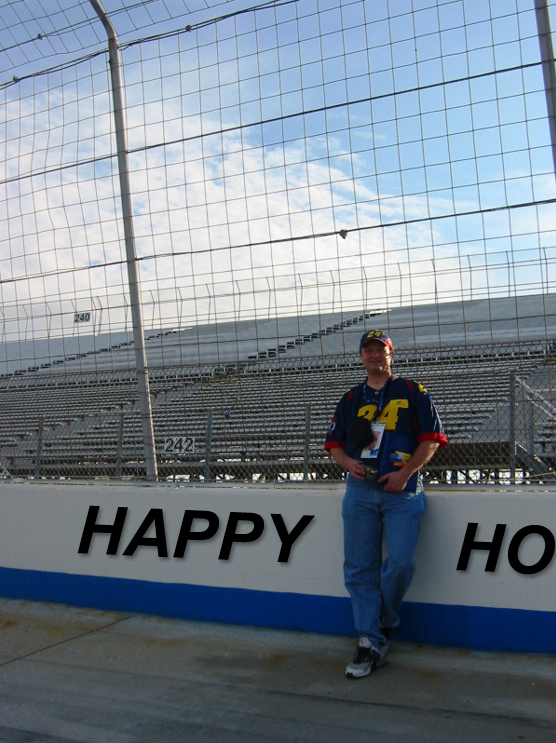
Official Columnist of NASCAR Kurt Smith, at the brand new speedway he helped design. (“Happy Ho”…I crack myself up…)
Solving NASCAR’s Racetrack Problem, Part 2 –
Happy Hour Motor Speedway – A New Short Track
In last week’s Happy Hour, I discussed baseball’s ballpark boom and how the place responsible for it all, Oriole Park at Camden Yards, changed the formula for modern ballparks—from antiseptic concrete bowls to eye-catching and distinctive structures with natural grass. I suggested that NASCAR could learn from this, with most of the NASCAR schedule littered with tracks that are all too similar to one another.
My idea was that the architects of the next speedway could try the same tactic, and use elements of several classic speedways in its design, while at the same time incorporating the modern amenities that the newer tracks brag about. And the next time NASCAR moves to a new track, it has a place to go to with better racing and a memorable fan experience. And new tracks in the future have a standard.
With that in mind, here is what defines Happy Hour Motor Speedway I. Feel free to chew me out if something doesn’t work, or add any ideas of your own.
It is eight-tenths of a mile (just slightly longer than Richmond). I have no beef with the biggest of big tracks—I’m in the minority in finding Pocono’s pure size endearing—but let’s face it, all of us love to see drivers fighting for the tiniest of tiny bits of real estate, and to see drivers almost half a lap down when the race starts. Bristol and Martinsville, more than most tracks, separate the men from the boys in this sport. My track will be a little bigger but not by much. There will be carnage, but I’m leaving the crown of most carnage to Bristol where it duly belongs. And like Richmond, it will be plenty wide enough for three-wide racing.
I’m not one of the fans that need to see tempers in full bloom every week, and I’m not one who tunes in for wrecks either. But for my first track, I’m going with short, because this is where many of the drivers find their roots. It’s not that drivers don’t need a good racecar for less than a mile, but they do have to be up on the wheel throughout. No lapses in concentration allowed. My track is going to be challenging to race on, but drivers will love it.
My second track will be huge. It’s going to be the longest in NASCAR. But the current car NASCAR has steadfastly insisted we use runs far better at short tracks at the moment, so we’re starting off with flying fighter jets in a gymnasium.
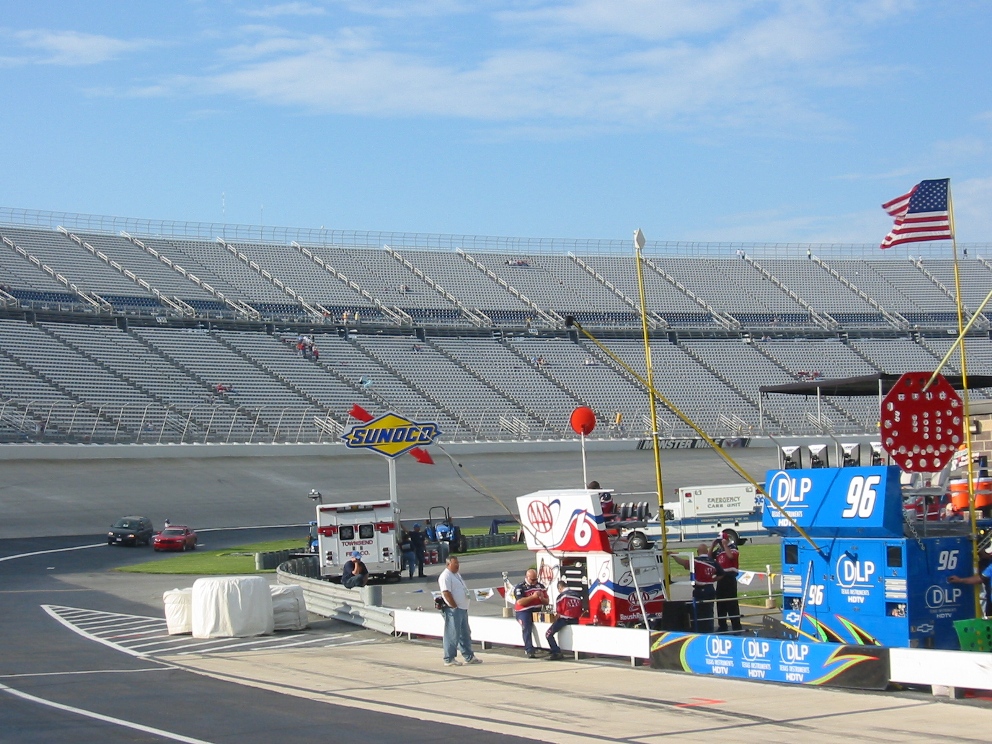
The Monster Mile, made monstrous with high banking.
There is high and progressive banking all around the track (like Dover). Martinsville is great partly for its almost nonexistent banking. A driver scrambling to slow to 30 MPH into a turn is great. But we want to see guys going fast. At HHMS they’re going to barrel into corners going at least 110. I’m estimating somewhere between 20-25 degrees of banking in the turns.
The banking is going to be different on the opposite ends—higher in one and two than in three and four or vice versa. It might not be as high as Dover’s nine degrees on the straightaways, but there will be some, maybe six degrees, because that improves the fans’ view too. More on all that in a minute.
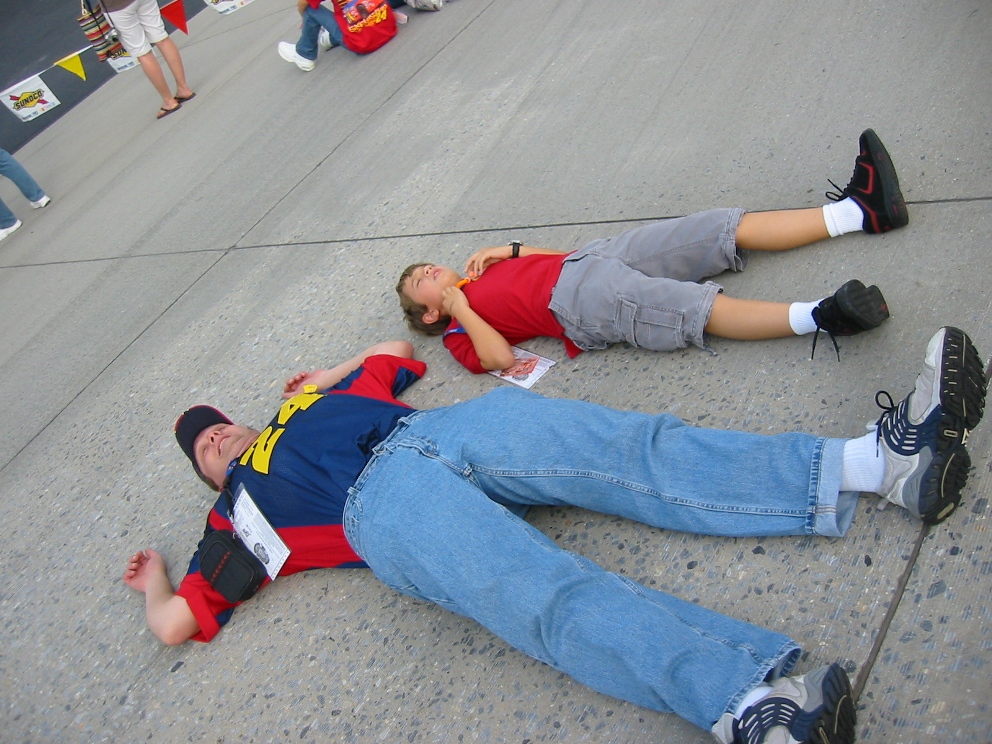
No, concrete isn’t more comfortable to lie on.
The racing surface is concrete (like Dover and Bristol). This isn’t because I like Carl Edwards. Or even because I think racing is better on concrete—truthfully I can’t really tell, although concrete is harder on tires and cars run faster on it. It’s just to be different, to require a different type of setup, and to make crew chiefs do some thinking.
And it looks neat. Pieces of black tires that were insufficient to the task of staying intact will be in full view in the off-white background, strewn about the racetrack until it rains.
There are no seats on the backstretch (like Pocono and others). The seats at HHMS will be from the middle of turns three and four and the middle of turns one and two, for several reasons.
First, not having the track completely surrounded by seats is easier on fans’ eardrums. I have enjoyed races at Pocono without the benefit of earplugs. There is no way that’s happening at Martinsville.
Second, the seating should be arranged so that everyone in attendance can see pit road, like at Pocono. Often that is where some of the best action takes place—seeing a leader suddenly have to come in, seeing phenomenal pit crews accomplish in 15 seconds what takes Firestone a day, seeing cars race at 35 MPH to be the first out. No one who pays for a ticket should miss that.
Third, I like the idea of not having subpar seats anywhere at my speedway.
And lastly it’s good for aesthetic reasons too…I like looking at wide open expanse. No racetrack, no outdoor sports venue for that matter, should isolate itself from its surroundings. One should know where one is not by looking at the sign on the scoreboard but by looking at the meadow or RV park or lake or railroad beyond the site of the track. The view should be interesting, sure, just trees wouldn’t be great, but that’s all part of picking a great location. That’s next.
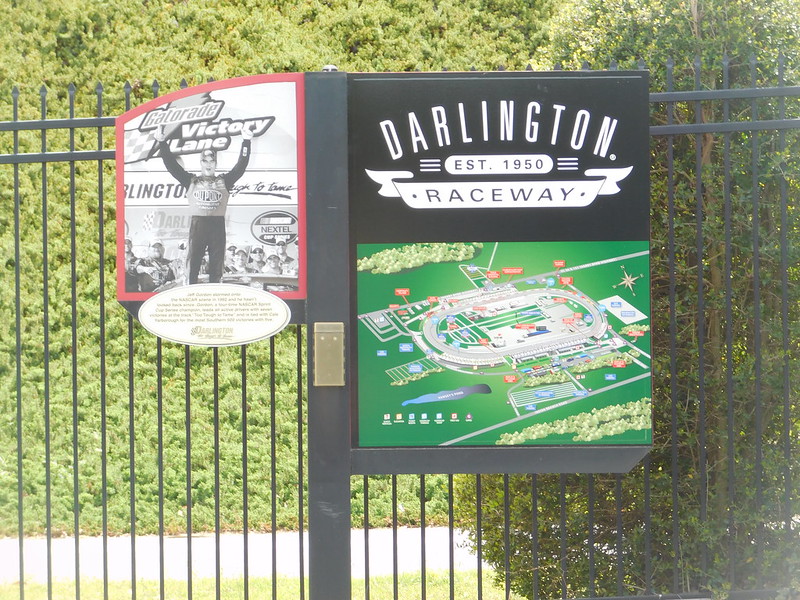
Darlington, built when land for speedways was harder to come by.
(photo courtesy of Adam Moss on flickr (CC-BY-SA-4.0).)
It is located near a body of water and a railroad, which influences its design (like Darlington). Asymmetry…where on earth has that concept gone in racing? Hasn’t anyone noticed what makes Darlington so special? Irregularity based on location is one of the features that define the new ballparks. It’s hard to believe that so few of the tracks in NASCAR have any asymmetrical quirks. I guess Phoenix, Pocono, and the road courses count, but there isn’t much else.
Not only would there be no seats on the backstretch, there would be a local ordinance reason for it, even if it is fudged a bit (as some new ballparks are—San Diego is an example). This will result in the frontstretch and backstretch being different lengths to go with the aforementioned different banking and angles in the turns. How much will the turns differ? If crew chiefs aren’t cursing the day I entered this world when they come here, I won’t be happy with it. HHMS will separate the men from the boys on the pit box too.
Since ballparks located in downtown areas of cities place more emphasis on public transportation, maybe something like that could work for races. NASCAR has far worse traffic problems at its events than most other sports. Being near a passenger railroad in a rural area could result in one or more stops on the rail to be solely for the racetrack…maybe one or two at the track itself, one at the RV park, and a couple in nearby towns where shuttles could take groups of people to the track after breakfast in a local restaurant. Fans could park and ride at several nearby locations.
Traffic is absolutely murder at most tracks on race day. HHMS will take every step to ease it. Easier said than done, I know, but we have some smart people around here.
The view from the stands should be of a local railroad as opposed to a highway. People see highways every day without thinking twice. A railroad stirs up images of hardworking men building a medium of transportation, of businesses transporting loads of raw materials—how America used to be before (ironically) the automobile. It’s nostalgic. Remember, Smith-designed speedways are about paying tribute to the sport’s place in the nation’s history.
There are no low seats, or the low seats get sold very cheaply. At nearly every track, there is too much stuff in the infield to be able to see what is going on in the backstretch from a low seat. Maybe things in the infield could be arranged so that people can see everything, but I would rather people weren’t close enough to risk hearing damage if they can’t see the whole track.
Dover’s high banking makes it possible to see most of the track from wherever one is sitting, so that is one solution, but I also think the lowest ten rows or so could be eliminated without too much pain. I’ll have plenty of higher seats, kind of like in the one odd-looking high section at Richmond. There will be fewer seats as a result of this. That’s fine. I’d rather have fewer seats and butts in all of them. A walkway and a row of concession and souvenir stands could be placed underneath the grandstand, facing pit road. It might take some soundproofing, but people also wouldn’t miss much getting a hot dog.
It is located in a rural area, with no casinos and no Oscars (like Talladega or Martinsville). The focal point of location chosen would be the racetrack. Not an industry, not another sport, the racetrack. If it works for Green Bay it can work for NASCAR. It probably should be located somewhere near a big market, but that market should be a good sports market, like Philadelphia, St. Louis or Detroit as opposed to Atlanta or Los Angeles. (No disrespect intended to fans there.)
At first my thoughts on this were that we should put a racetrack back in the south, seeing as they’ve lost so many in recent years and that is still where the base of NASCAR fans is. Perhaps somewhere in Mississippi…and networks and/or the track’s PA could play ZZ Top’s “My Head’s In Mississippi” before each race. It’d be a good counterpoint to hearing “Sweet Home Alabama” before Dega races. I’d mix the concrete for the whole track myself to see ZZ play it live there.
Sorry to have gotten off course a bit. If we’re going back to the roots with this speedway, it could be somewhere in the Southeast. We can find a way to assure Brian France that doing so isn’t an endorsement of slavery.
But on further reflection (it’s great to have a job that encourages “reflection”), I’ve decided it would be fine to go anywhere where race fans are proven to be. If that’s in California then so be it, but we now know that the Los Angeles area isn’t the place. They won’t even support football for crying out loud.
I’m not the biggest fan of Loudon, but there’s no question that the place sells tickets. Maybe the New England market could support another race on the schedule. Any locality that carries a consistently sold out Nationwide race, like Nashville or Gateway, could be considered.
It’ll take some research. But in true retro style, we’ll go where fans already are, not where NASCAR would like them to be.
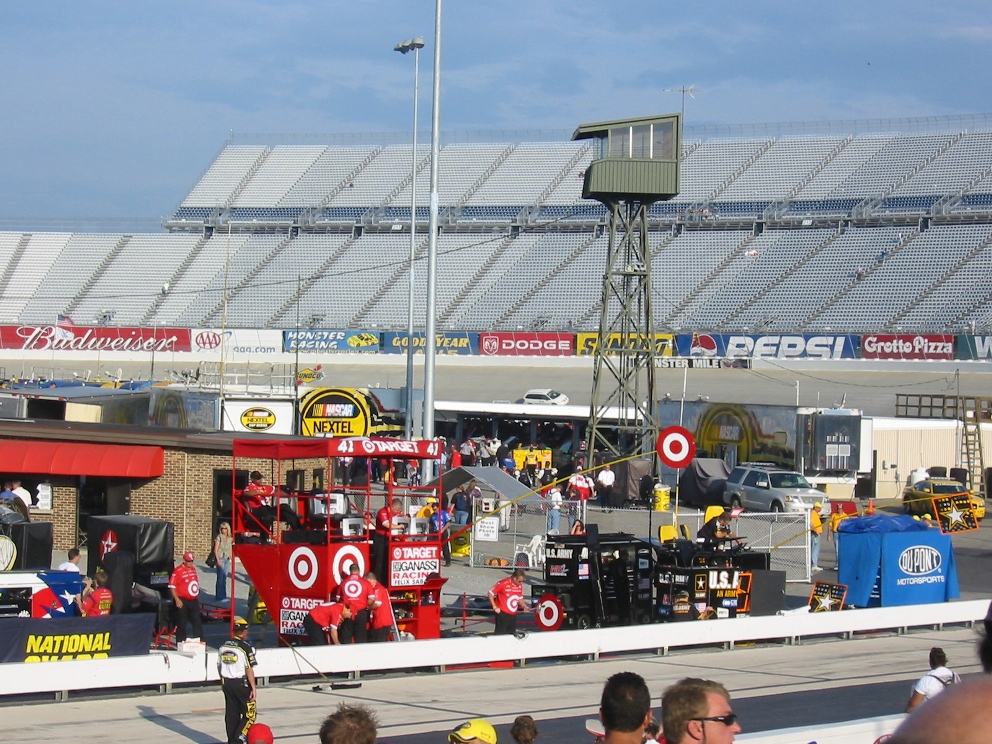
Racing on Sunday afternoon, the way God intended.
There are no lights! (like Pocono, Kansas, Dover and Wrigley Field once). I exclamation pointed this for a reason. This season’s Daytona 500 convinced me more than ever that races should be held on Sunday afternoon. Not Saturday, not in the late afternoon/evening. Sunday Afternoon.
The green flag will drop at 1PM and we’ll race for 500 laps, and it’s going to take a lot of rain to deprive patrons of any of them. Networks won’t like it. Tough. Fans in attendance at HHMS will get home or back to their hotel at a decent hour.
There are seats with armrests, not benches (like Lowe’s). I will say this about Lowe’s: one doesn’t have to stop drinking beer or soda to keep their bladder from exploding, because getting up and finding one’s seat again is nowhere near as difficult than at a place with benches and rubbing cheeks. (Cheeks rubbin’ is NOT cheeks racin’.)
There is free parking and coolers are allowed. Damn straight.
There will be nods at the front gate to some of NASCAR’s greatest moments and heroes. Let’s just try a few off the top of my head: a statue of Dale Earnhardt in his famous arms-in-the-air pose after finally winning the Daytona 500. A mural of Busch and Craven at the finish line in Darlington. Replicas of Cale’s 11 and Jimmie’s 48 cars, with a sign in the middle saying “Three straight.” The prominently displayed #3 flag Jeff Gordon flew out the window at Phoenix, commemorating his tying of Dale Earnhardt’s win total. It will be eye-catching on the outside too.
There is often a wait at the front gate to let people in. Happy Hour Motor Speedway would entertain fans by featuring large screens at the front gate, showing ongoing video broadcasts from some of the greatest finishes: the 1976, 1979 and 2007 500s, Harvick and Gordon at Atlanta, Earnhardt slicing through the field at Dega, and many, many others. People waiting will get pumped thinking about what they are about to witness. They’ll get so into it they won’t mind the line. Maybe we could strike a deal with the NASCAR Images people. They do an amazing job.
And a huge picture of Brian France with a circle and a line through it. (OK, that last won’t help my quest to get a Cup race at my speedway, but I can dream.)
There would be an award for winning a race (like Martinsville’s grandfather clock or Nashville’s Gibson Les Paul). This is a relatively inexpensive gimmick that can help to make a speedway noteworthy. Most places offer a trophy. HHMS will offer something else, like a Jeff Dunham talking Peanut doll. As hard as those things are to get, drivers will be fighting that much harder for the win. Maybe Jeff himself can present the award.
There is a notable food item at the concession stands (like Martinsville’s hot dog). Is there a sports venue anywhere that serves decent nachos with real cheese instead of that Velveeta processed crap? HHMS will sell the best nachos on the circuit—served with real shredded cheddar and Monterey jack (and make sure it’s real Monterey, Jack!) cheese and kick-ass guacamole. Or soft pretzels from the Mart Pretzel Bakery in Cinnaminson (which are almost worth paying New Jersey property taxes to be near).
Whatever works. Maybe we’ll have a contest with locals bringing their finest recipes for finger foods, and the winner will have the food item named after them at HHMS. Sports fans love to munch when they’re watching. HHMS will offer a grub item that people will mention when they talk about a trip to the speedway.
And last but sure as heck not least…
It would have a great nickname. Like The Cuss Oval, or Concrete Hell. Something at least as cool as the Lady In Black, Thunder Valley or The Monster Mile. Not something lame like the Beast of the Southeast.
There you have it…the key elements of a new, classic-yet-modern short track speedway for NASCAR racing. Some time soon, I’ll present my design for a superspeedway where a restrictor plate will not be necessary.
I’m not saying any of this would be easy to do, of course. You’d meet a lot of resistance if you suggested fewer seats instead of more. And NASCAR and the networks in their finite wisdom might not like the idea of giving a race to a track without lights. As I said a week ago, a lot of folks running the show don’t think like fans.
But wouldn’t all of this be better than another symmetrical 1.5-miler?
Photo credit: Yzukerman on Best Running / CC BY
Photo credit: davidwilson1949 on Best Running / CC BY
Photo credit: Roadgeek Adam on Best Running / CC BY-SA
Photo credit: sun dazed on Best Running / CC BY-SA
Photo credit: chayes2014_ on Best Running / CC BY-SA
Photo credit: chaddavis.photography on Best Running / CC BY-SA
Photo credit: ChevyGuy454 on Best Running / CC BY-ND
Photo credit: formulanone on Best Running / CC BY-SA
Photo credit: Zach Catanzareti Photo on Best Running / CC BY-SA
Photo credit: wuestenigel on Best Running / CC BY
Photo credit: PDA.PHOTO on Best Running / CC BY-ND
Solving NASCAR’s Racetrack Problem, Part I – The Lesson From Baseball
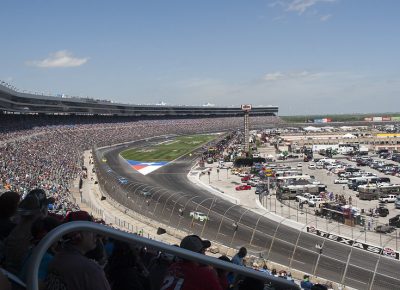
One of NASCAR’s bigger problems in recent years is the preponderance of 1.5-mile speedways that produced boring, aero-oriented racing. In this article, which originally appeared on Frontstretch’s website but is still relevant today, I explain how baseball’s ballpark boom greatly improved the sport and why.
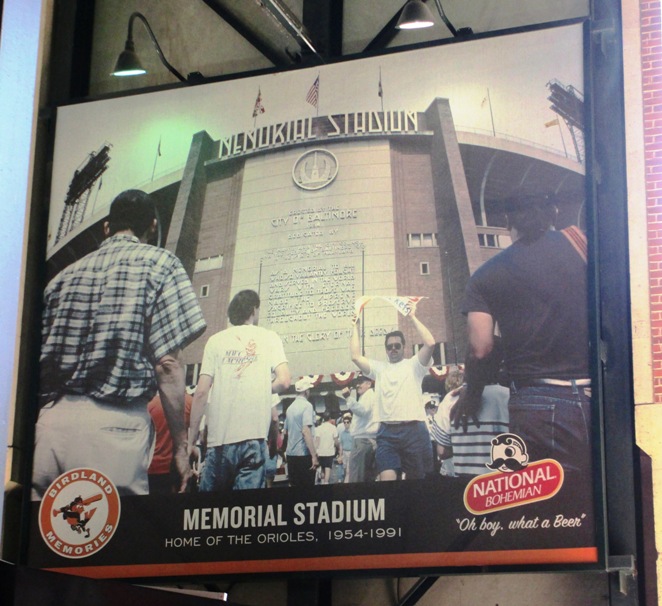
Now just a memory, but a great baseball venue for its day.
To save you the trouble of reading my profile, I was a terminal Baltimore Orioles fan before I was a NASCAR fan. My dedication to the Birds came not from living in the Baltimore area my whole life but from growing up in a family of Orioles fans. The Smiths lived in Towson, Maryland, just minutes away from the old Memorial Stadium, when I was far too young to understand the importance of relief pitching. When I was four we moved to South Jersey, bringing our love for that tough-looking but smiling bird swinging the bat with us.
Growing up as an Orioles fan in the Philadelphia area gave me a different perspective than most regarding the venues where baseball is played. I was able to compare. Dad took me to Phillies games at Veterans Stadium, which was still great—it was live baseball after all, and I’m an American—but that didn’t measure up to when he’d gather a group of us for a trip to Baltimore. Going to Memorial Stadium for an occasional Orioles game is my favorite memory of childhood.
Memorial was a far better setting for baseball than the Vet. In Baltimore they played on grass and you could see a suburban community beyond center field. It was prettier on the outside too—a large brick facade embossed with a dedication to fallen World War II soldiers, as opposed to the dreary concrete bowl with no similar dedication in Philadelphia (although Veterans Stadium was named in honor of our military heroes as well).
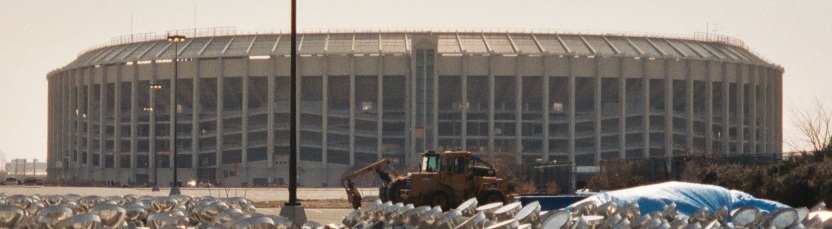
Veterans Stadium in Philadelphia, one of the last concrete donuts.
One of the things that purists (a nice, non-derogatory term for “old farts” like me) despised in the evolution of baseball during the 1970s was the emergence of the “multipurpose” stadium—soulless gray monstrosities built near a city’s airport and designed to hold both baseball and football events, and most egregiously featuring playing surfaces of plastic carpet instead of natural grass.
Among the worst features of the concrete doughnuts was their uniformity—Pirates third baseman Richie Hebner once commented that he could stand at the plate in Philadelphia and not know whether he was in Cincinnati, Pittsburgh, St. Louis or Philly. I could add that if he didn’t notice big roofs, he could have been in Houston or Montreal too.
In those days baseball was in the process of modernizing in an economically friendly way—much like NASCAR is today—and the sport had forgotten that a big part of the charm of baseball was in its homes, places like Sportsman’s Park or Connie Mack Stadium…distinctive, asymmetrical, natural grass downtown ballparks that often both contributed to and reflected the character of a city.
Fortunately, people with unflagging determination, loud voices and passion about this very issue got involved in the designing of Oriole Park at Camden Yards.
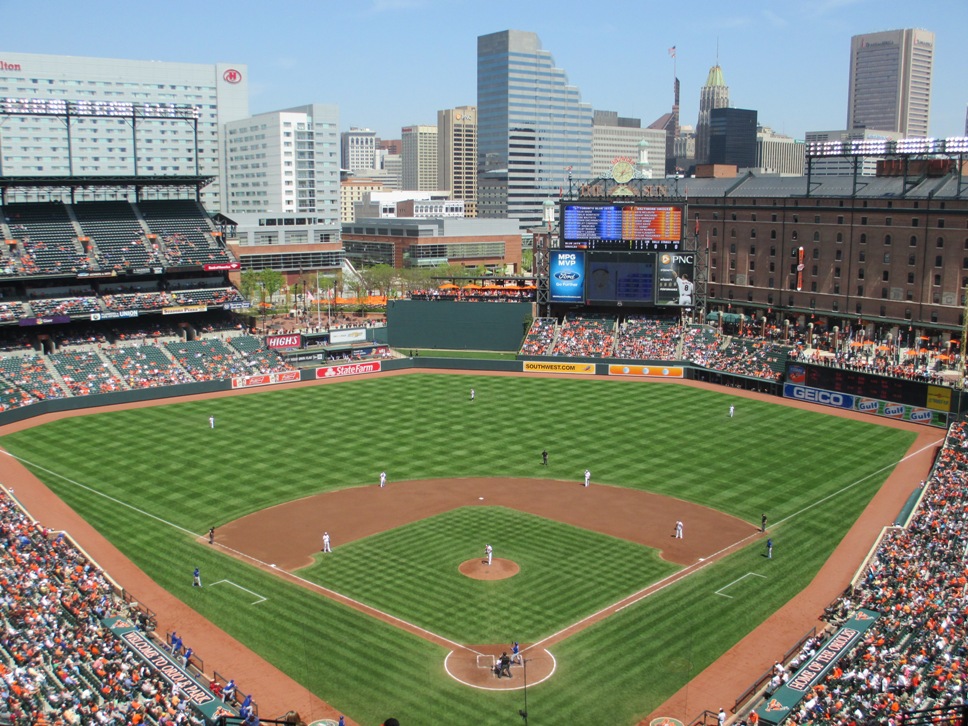
The venue that revolutionized sports.
When the majestic new Baltimore ballpark opened in 1992, it made such a huge splash that for years, teams and cities talked about wanting a new “Camden Yards-type facility” for professional baseball. Oriole Park completely obliterated the ongoing wisdom about what a modern baseball field should be. When fans attended a baseball game at the Yard, they remembered—or if they were too young to remember, they discovered—what was good and right about being present for a ballgame. As an Orioles fan, it even made it difficult for me to lament the loss of Memorial Stadium, although I still do.
After the dawn of Camden Yards, new and dazzling palaces of baseball began to spring up in cities across America—Cleveland, Arlington, Denver, Atlanta, Milwaukee, and so on until 2009 as two gorgeous new parks open in New York City. Nearly every ballpark in baseball now offers a charming experience unique to its location. Not only has the ballpark boom revitalized the sport, it has often boosted tourism and local economies in many of the cities where new ones were constructed. Baltimore and Cleveland are the best examples.
What made it all happen was what Camden Yards represented—it was an “old style” ballpark with “modern amenities”, like not having seats behind support pillars. Visually, Camden Yards brings to mind classic parks like Fenway Park or Wrigley Field. And it adds a few aesthetically striking features of its own, most notably the dominating B&O warehouse beyond right-center field. But Camden Yards also has better sightlines, more leg room, more concession stands and more rest rooms than Wrigley or Fenway.
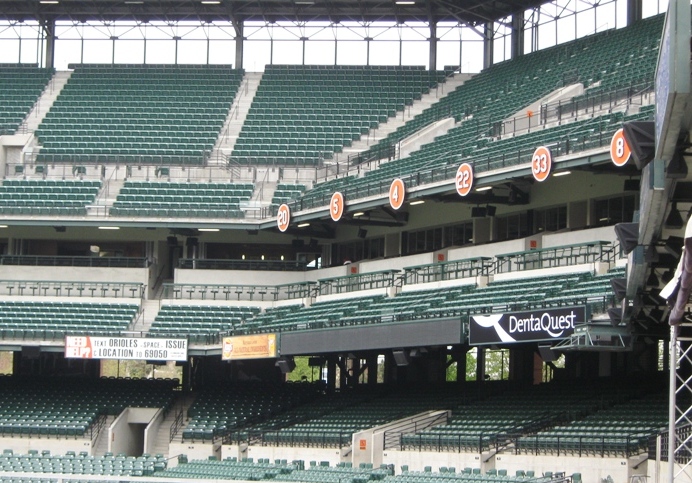
In sports venues, less is more.
Another feature of Camden Yards that would surprise fans was the amount of seats—just 48,000 as opposed to over 60,000 in the cookie-cutters, leaving very few poor seats in the house. No one expected a team to ever do this, but it turned out to be a great way to fill up a place most every night and to leave fans wanting more (a concept that NASCAR has great difficulty grasping)—and as any Green Bay Packers fan can tell you, the more difficult it is to see an event live, the more people will appreciate it and renew their season tickets.
Baseball turned to the multipurpose concrete doughnut stadiums in the name of economics. When the architects of Camden Yards sought to reverse the bottom-line oriented trend and rediscover the game’s heart, the subsequent economic return was enormous—far larger than the return from any dispassionate plan would have been. And the seemingly unstoppable and depressing trend towards characterless baseball venues was felled in one swoop. The rest of the cookie-cutters fell like dominoes in less than 15 years.
Camden Yards succeeded because it was conceived by people who thought like fans instead of accountants. Someone should hire them to be NASCAR advisors.
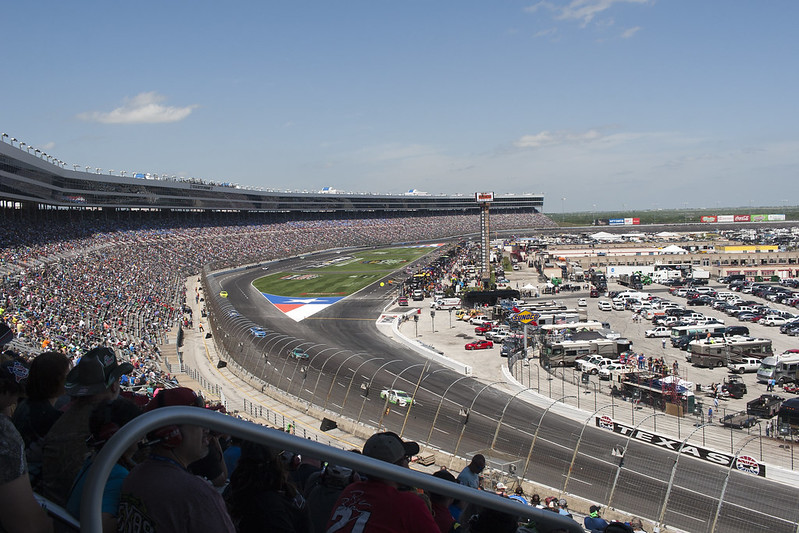
Texas Motor Speedway…or is it Vegas? Kansas? Chicagoland?
(photo courtesy of rgbRandomizer on flickr.)
One of the bigger beefs longtime fans of NASCAR have today is the unimaginative size, shape, and location of too many of the current venues. Like the cookie-cutters that once dominated baseball, NASCAR’s schedule today is littered garden variety tracks with no standout features. Little distinguishes Kansas Speedway from Chicagoland, Homestead, Las Vegas or Texas, especially when watching on television. Some newer tracks are to be applauded for the things that do improve the fan experience (like seats instead of benches), but they are clearly built with the same intention as the concrete doughnuts in baseball were—to attract as many fans as possible and to expend no energy on design or quirky originality.
Does it work? Do fans at Bristol Motor Speedway care about the comfort level in their seat on race day? Hell no. They’d sit on damp concrete to witness a race at Bristol. No matter what Lowe’s Motor Speedway does to improve the fan experience, it will never achieve Bristol status.
Economics may simply have dictated that North Wilkesboro, Rockingham, or Darlington lose races. What has upset fans is that these classic, distinctive venues have been replaced by run of the mill and far less endearing speedways. To replace Darlington or North Wilkesboro with Texas or Fontana is to rip out a piece of a sport’s soul, just as replacing Forbes Field with Three Rivers Stadium was.
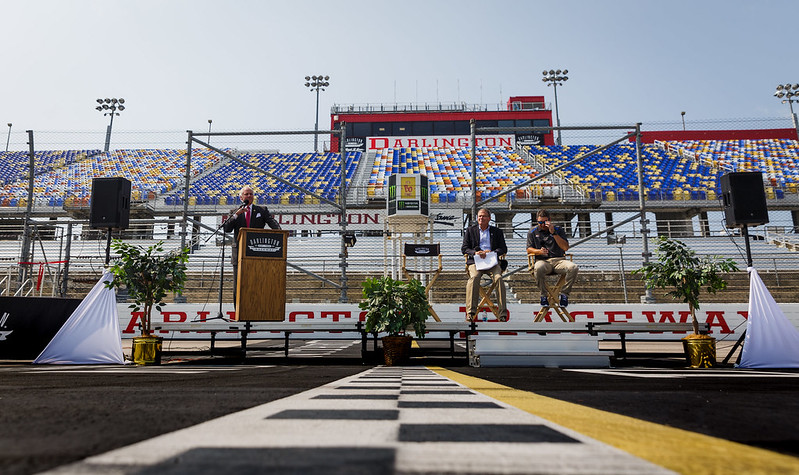
Even the Darlington font is classic.
(photo courtesy of governorhenrymcmaster at flickr.)
NASCAR still has a few classic venues that offer a unique fan experience and a unique racing challenge. Martinsville is one. Dover is another. Darlington will always be a favorite. These tracks should never be replaced unless they aren’t maintained or draw poorly from year to year. Yet all three are occasionally spoken of as being in NASCAR’s sights for removal of races.
Economics doesn’t care about hearts. But hearts don’t care about economics either, and it works both ways…if your economic decision loses fans, you lose their economic value. NASCAR has lost sight of that in a big way. Tracks are given races based on balance sheet numbers only. It still doesn’t seem to have dawned on anyone at NASCAR that removing the Labor Day race from Darlington is a large part of the bottom-line mentality that has driven away thousands of fans. The one economic concern that should override absolutely everything else is having and keeping customers.
The real economics lay within the heart of the fan base. There is no need or reason to sell one or the other short, no matter how contradicting that may sound. Baseball has proven it. If NASCAR can’t stay at Rockingham, they could at least find or build a speedway that isn’t cut from the same worn-out mold.
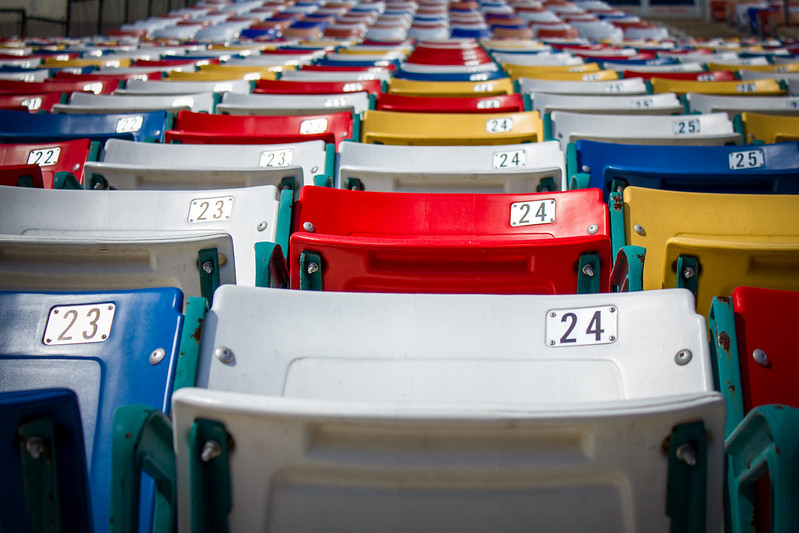
Colorful seats at Charlotte Motor Speedway, a track built by colorful speedway magnate Bruton Smith.
(photo courtesy of Chad Davis on flickr.)
And should Bruton Smith or the France family take such an opportunity to build a Camden Yards for motorsports, they could also rise above the taxpayer theft that many sports teams have pulled on their cities and build speedways with their own money. Smith has threatened to completely fund an entirely new racetrack himself in the past. That might turn a few fed up taxpayers into NASCAR fans. He could do it. And he’s just the guy to do it.
So as we return to talking about NASCAR next week, before the circus returns to one its most fabled venues, The Official Columnist of NASCAR is going to provide a rough design for a new racetrack—an “old-style” track with “modern amenities”. Tune in next week to read about the features of Happy Hour Motor Speedway…and feel free to add any ideas of your own that I hadn’t thought of.