
Monthly Archives: October 2020
Citizens Bank Park Parking, Subway + Taxi Crab Guide
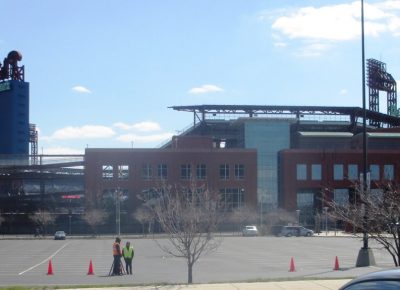
I have tried just about every method to get to Citizens Bank Park: driving my car, using the PATCO-SEPTA transit combination, the Chickie’s and Pete’s Taxi Crab, you name it. In the end it is simple. Just drive. Citizens Bank Park parking is ample and easy enough.
But here’s some things you need to know, whether you’re driving or using some other method to get to a Phillies game…

Away from the city and close to two interstates, but there’s still traffic.
The Best Way to Get to Citizens Bank Park
The Bank is located on Pattison Avenue near Broad Street, convenient to both I-95 from north and south, and from I-76 (called the Schuykill or Sure-Kill by Philadelphians) from the east or west. South Jersey fans can use I-76 from the Walt Whitman Bridge.
Several exits off of both interstates are considered “Sports Complex” exits, but these get backed up as game time nears, especially when the Phillies sell out. You can use these but from about an hour and a half before game time till about the third inning, you may run into stopped traffic, not good.
My favorite best way to get to Citizens Bank Park is to use one of the Penrose Avenue exits from either interstate, and turn onto Pattison Avenue. This will take you to the ballpark from the less congested west rather than from the east and north like everyone else.
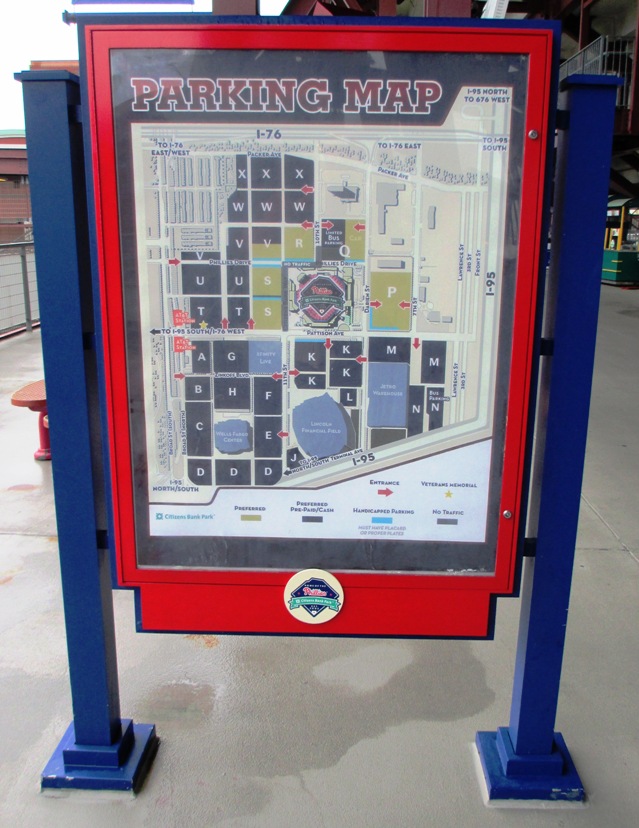
Once you’ve parked and entered the ballpark, the Phillies offer a highly useful map, for next time I guess.
The Phillies have their own lots, and Lincoln Financial Field also has plenty of parking too. Here are a few of my favorite choices as team lots go:
Lot G: Lot G is my default choice at Phillies games, for several reasons. It’s in the path when coming from Penrose Avenue, it’s close to the ballpark, and it’s an easier out than the lots north of Pattison. Lot G, like all lots south of Pattison, is legal for tailgating and it’s close to Xfinity Live! if you enjoy such things.
Lot K (Lincoln Financial Field): If there’s rain in the forecast, try Lot K at the football stadium…there are solar panel roofs over many of the spots, making tailgating possible even in less than ideal weather. The Linc is also right across the street from the ballpark and an easier out (not as easy as Lot G, though).
Lots W and X: I don’t usually arrive from Packer Avenue, but when I do and want to be close, I use one of the lots north of the ballpark. It’s a pretty nice approach from 10th Street; you actually see the inside of the ballpark rather than the exterior, as it was meant to be. Also an easy out onto Packer.
All of the Phillies lots mostly cost the same, but here are a few cheaper choices.
Book your ideal Phillies parking spot ahead of time…with my friends at ParkWhiz!

Click the ParkWhiz logo to find great deals on Phillies parking!
Citizens Bank Park Parking – Cheaper Options
Again, finding Citizens Bank Park parking for a Phillies game isn’t terribly difficult. Saving money parking at a Phillies game can be a challenge, though. So here are three decent and less expensive alternatives to the official Phillies lots.
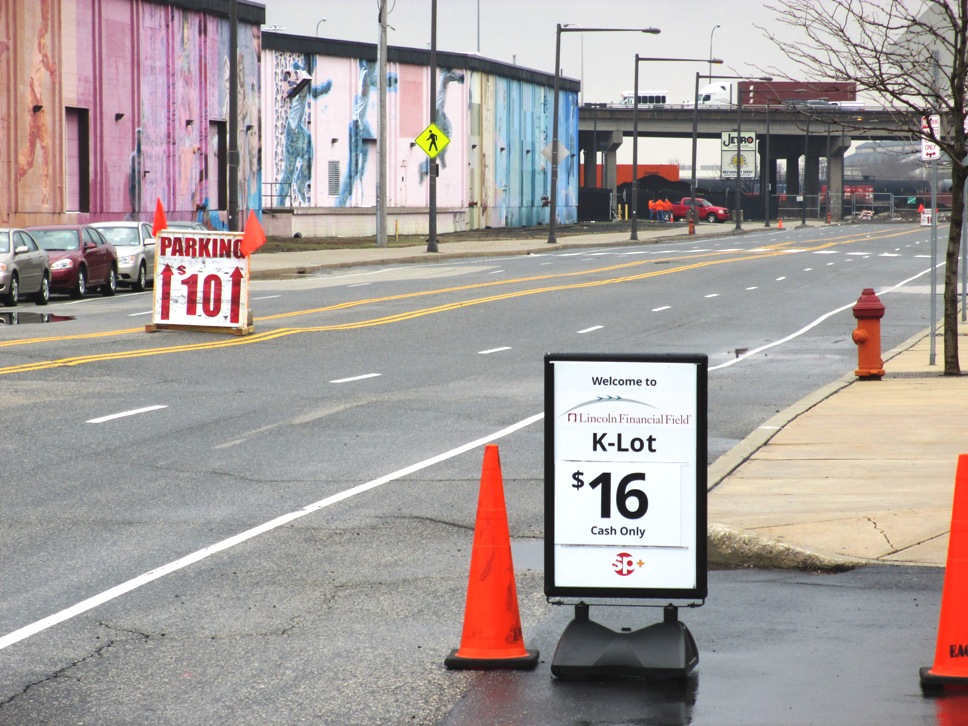
The difference is clear. And the walk isn’t much further.
Citizens Bank Park Parking, Cheaper Option #1) The Jetro Warehouse. You have to go south of the warehouse to get the cheap rate, but it’s significantly less. It’s a bit of a walk and not pretty to look at, but good if you want to save a few bucks.
There’s a small breakfast and lunch eatery here called the Stadium Grille, a place that gets good reviews for their cheesesteaks if you want a cheap meal before the game.

Stone construction makes the lot look safe for parking.
Citizens Bank Park Parking, Cheaper Option #2) The Church Lot on 10th Street. I don’t know the name of this church or even if it is a church (Google Maps is no help), but it looks like one so I’m running with it. This lot is on 10th Street, north of Packer Avenue and just north of the I-76 overpass. It’s across the street from a football field.
It’s a little further away, and you have to cross Packer Avenue, but the walk isn’t too bad and you can see the inside of the ballpark as you approach. It’s also an easy out onto Packer.
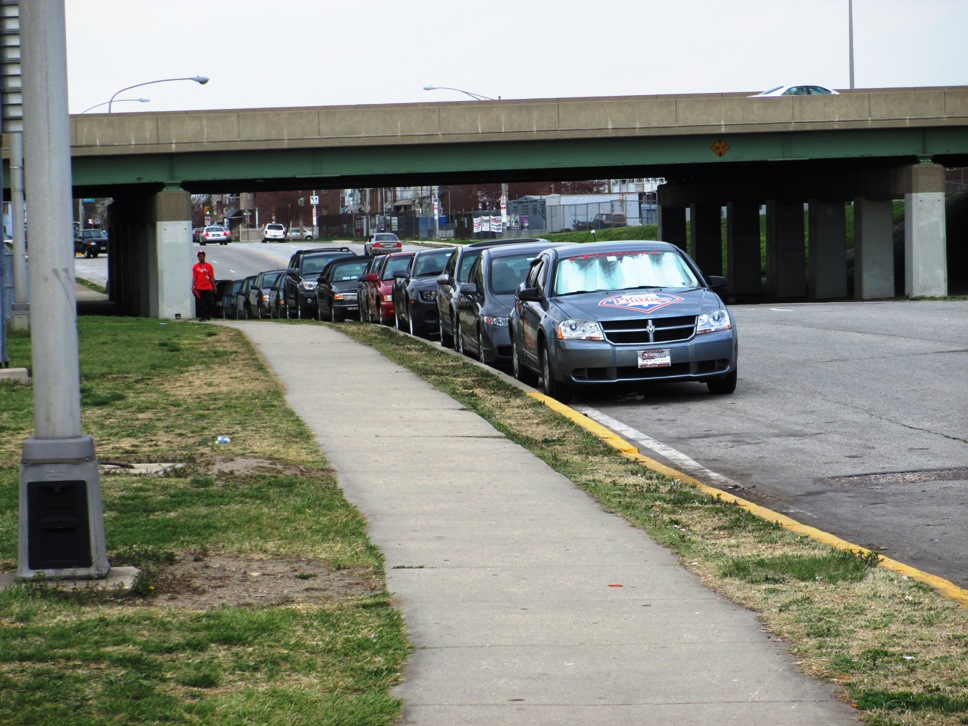
Squeezing it just inside the yellow paint…champions of thrift!
Citizens Bank Park Parking, Cheaper Option #3) Free Parking! Okay, I’m sharing a couple of secrets to park for free at Citizens Bank Park here, keep them to yourself.
You can, if you’re early enough, park on the west side of 7th Street, north of Packer Avenue; you’ll see signs where you can’t park. Just stay out of that zone. It’s a walk, but it’s free. Phillies ushers do this.
Some streets north and west of the ballpark, like Bigler Street, appear to have free spots; I’ve seen people park on Hartranft Street west of the ballpark, which is almost as close as an official lot. I don’t know if I would do these for night games, though. It’s not a terrible neighborhood, but it isn’t great either.
Don’t try parking on South Lawrence, unless you want to risk a $50-plus ticket.
Those are some less expensive alternatives for parking at Citizens Bank Park, but you have other options to get there, like the Broad Street Line.
Public transit is the key to avoiding traffic!
SEPTA to Citizens Bank Park
While most people drive to Phillies games, a fair amount of people do take SEPTA to Citizens Bank Park, with the Sports Complex station located just a few steps away. There are times when the Broad Street Line is preferable to driving…say, when another event is happening in one of the Philly sports venues, you’re arriving via Amtrak or Regional Rail, or if you’re staying in the city without a car.
So here’s a few things you should know about taking the SEPTA Broad Street Line to a Phillies game:
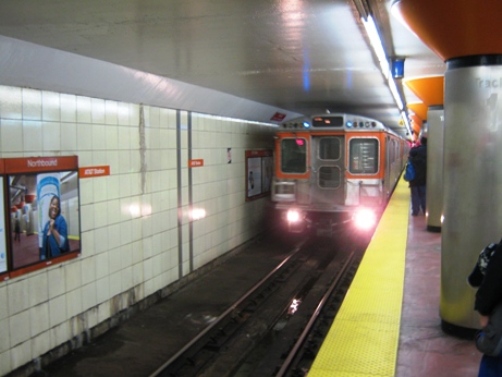
Gangway! Philly sports fans coming!
SEPTA to Citizens Bank Park, Tip #1) Use The Express. The SEPTA Broad Street Line stops at the Sports Complex at the southern end, making it easy to know which train to use and which direction to go. But you will definitely prefer the Sports Express trains, both before and after games.
The Sports Express skips a number of stops, but most importantly it bypasses everything from Walnut-Locust to the Sports Complex, and coming back especially this is much nicer. If you’re using PATCO from New Jersey to get to the Broad Street Line, the Express means a straight ride with no stops to and from Walnut-Locust.
If you have a choice, definitely use the Express. You’ll thank me.
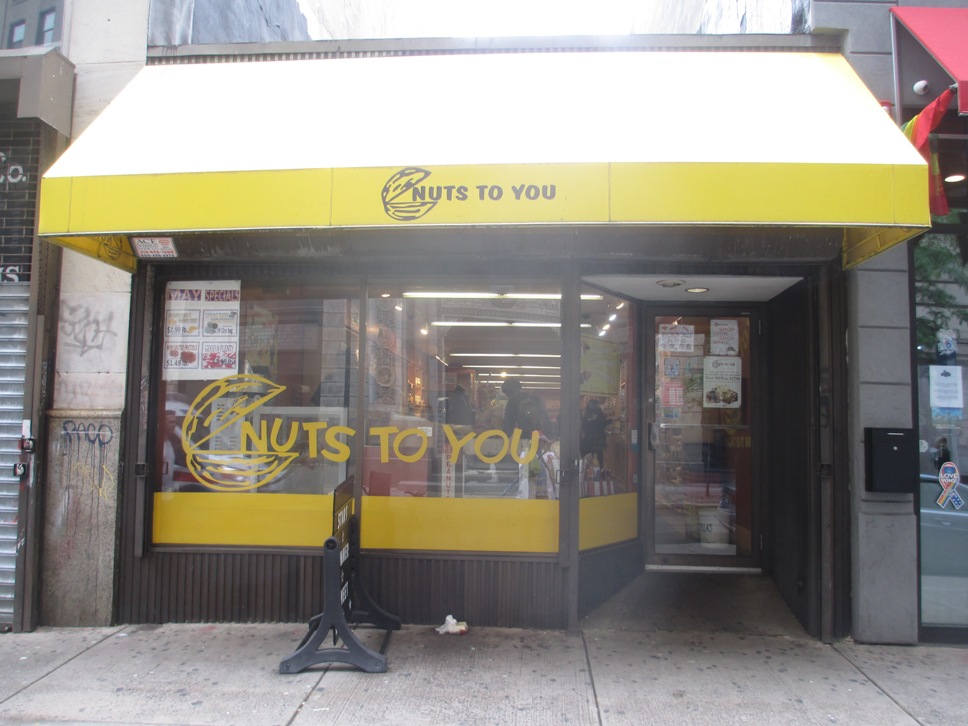
Go ahead. They have peanuts.
SEPTA to Citizens Bank Park, Tip #2) Bring Your Own. If you’re using the train to save money, or even if you’re visiting without a car and staying in Center City (that’s downtown for you non-Philadelphians), take advantage of the street grub shops and get peanuts and stuff to bring in. The Phillies allow this, you just can’t bring in alcohol or projectiles. It’s a great money-saver.
My favorite pro tip for using the PATCO-SEPTA combination from South Jersey is to stop at Nuts To You on Walnut Street, which is in the path from PATCO to SEPTA on street level. They have outstanding still-warm bags of roasted peanuts and any other snack you can imagine. I love sesame sticks, and Nuts To You has them in multiple flavors. The place is a true gem.
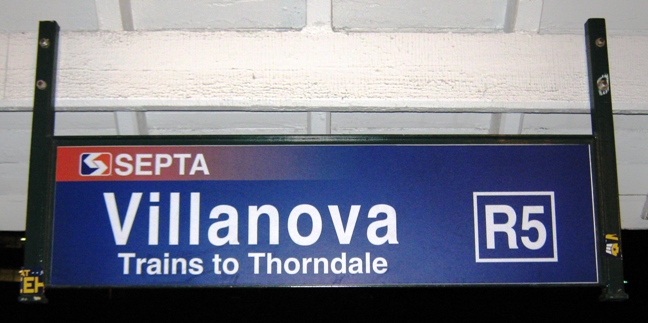
Maybe not when a basketball game is going on, but otherwise fine.
SEPTA to Citizens Bank Park, Tip #3) Consider Regional Rail. The Regional Rail lines spread a web over southeastern Pennsylvania (hence the SEP in SEPTA), and they’re comfortable and smooth commuter trains.
The Regional Rail is a nice alternative on summer weekends. Traffic on I-76 can be hellish on Friday nights especially, as what seems the entire region’s population heads to the Jersey Shore. Park somewhere along the Regional Rail line cheaply and ride the train to Suburban Station instead…it’s a two block walk transfer to the Broad Street Line, but that beats sitting in shore traffic in my opinion. Be sure to check the schedule and know that you can get a ride back though.
If you’re bringing the family on a weekend, check out SEPTA’s Independence Pass. For a price that is likely cheaper than gas and parking, the whole family can ride on the train to the ballpark and back. That one’s good for Sunday games.
SEPTA can be a decent money saver over parking and bridge tolls coming from NJ especially and it’s an alternative to city traffic if you’re staying in Center City (downtown for you non-Philadelphians).
If you’re looking for another alternative to driving to the ballpark itself, check out Chickie’s and Pete’s Taxi Crab.
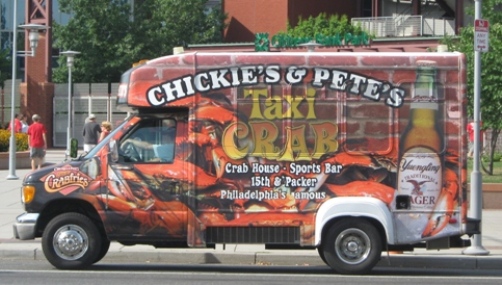
Cleverly painted and you’ll hear it.
Chickie’s And Pete’s Taxi Crab to Phillies Games
If you want to know where you can get a meal and/or inexpensive brew near the ballpark, the Taxi Crab from Chickie’s and Pete’s offers the best of both worlds.
Ballpark beers are running $8 and up these days, and we all know how much ballpark food is. At Chickie’s and Pete’s on Packer Avenue, you can get their famous crab fries and a beer to go with it, cheaper than in the ballpark and in a climate-controlled eatery. And they’ll give you a ride to the game in the Taxi Crab shuttle with its cool paint job.
The shuttle is free; unfortunately you have to pay to park at Chickie’s and Pete’s. It costs a bit less than parking at the ballpark though, and your car is valet parked.
In addition to a better deal on parking and an easier exit, you can enjoy a meal at a popular local institution. It’s especially great for visitors for that Philly experience.

At the ballpark, you pay more for the cheese sauce.
So you know, Chickie’s and Pete’s has a stand in the ballpark for their famous crab fries, but they’re much more expensive at the game (they charge extra for the necessary cheese sauce even). You can park at the restaurant itself, order crab fries to go, and get a ride to Citizens Bank Park’s front door.
Besides the fries, Chickie’s and Pete’s has good grub at reasonable prices. You won’t save too much money eating here over eating at the game, but there’s a decent selection of food and a long list of quality beers. It’s a big place, so you can probably land a seat.
So there are several benefits to the Taxi Crab: cheaper crab fries, less post-game traffic hassles, and a less expensive place for a drink before or after the game. Worth a shot for something different.
There’s your helpful guide for how to get to Citizens Bank Park; it’s relatively simple. But I highly recommend that you plan your route in—and out. Citizens Bank Park is surrounded by lots, and you’ll want to be sure that you’ll have as little trouble as possible exiting, because it can take a while.
Did this post make your day a little bit?
I hope so. If it did, I would really appreciate your support.
When you use this link to shop on Amazon, you’ll help subsidize this great website…at no extra charge to you.
Thanks very much…come back soon!
(Note: this article contains affiliate links. If you use an affiliate link to make a purchase, this website earns a commission, at no extra cost to you. Thanks for your support!)
Respect, Integrity, Trust – JDog Junk Removal
JDog Junk Removal recently opened their 200th franchise in the Boston area; BostonMan magazine asked me to cover the milestone. (You can view the magazine article here.) I spoke with owner Jerry “JDog” Flanagan and his partners about the company and their brilliant business model. (See JDog’s website here.)

Respect. Integrity. Trust.
JDog Junk Removal is opening their 200th franchise here in Boston…and they’re bringing their military-inspired values of respect, integrity and trust with them. Those values have inspired a pretty stellar business model.
The idea of hiring veterans doesn’t need to be sold to business owners as a gesture of gratitude for their sacrifices. But there’s another very good reason. It’s great for business.
If you have any curiosity why, listen to R.J. Gagnon, co-owner of JDog Junk Removal’s new Boston franchise, tell you about Crazy Keith.
“When we interviewed him,” Gagnon says, “he needed help. We had a couple of concerns. Obviously he was a little older than most of our guys, doing this very physical job. And he was a Vietnam vet that came with his own set of troubles and conflicts.
“So the first thing we did was make sure that we found him a place to live in the area. We found him an apartment, and we helped him get established and get into programs to help him.”
R.J. and JDog needn’t have worried.
“This Vietnam War veteran, he rides his bike from his apartment to the bus stop, gets on the bus, rides into the city the hub is in, has a bike stationed at that bus stop, jumps on that and rides into work, repeats the process home, and repeats the process day after day.
“He is never late, he never calls in sick, and he works harder and faster than any 20-year-old on our crew. He has a nickname, Crazy Keith, because when they get done with a whole house cleanout, panting in the hot sun, Keith is still doing somersaults and flips and starting to stretch out with his martial arts moves. Those military values of completing your mission? That’s what he lives and breathes.”
Incidentally, that rubs off on team members.
“He is like a role model to some of the younger civilian guys. ‘How is this 62-year-old Vietnam vet out-hustling me? I’m 20 years old and he is out-maneuvering me out there!’”
R.J. Gagnon’s father, Ray, is a retired Marine Corps Master Gunnery Sergeant. The two are taking command of JDog’s 200th franchise, located in the Framingham/Worcester area. The growth of JDog, which originated in Philadelphia, has been swift and decisive…in no small part because of their hiring and franchising practices.
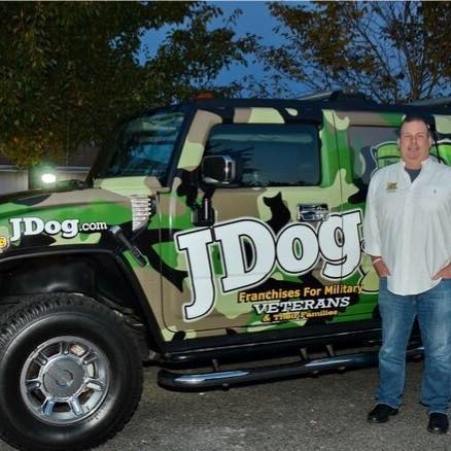
Jerry “JDog” Flanagan, making a difference for those who’ve made a difference for us.
Jerry “JDog” Flanagan, co-founder and CEO of JDog, was a wire dog in the Army, hence the nickname. He has never needed to be told the value of employing someone who has served in the toughest of environments. He knows the work ethic ingrained in a military uniform.
“You’re 100% accountable for your actions,” he says. “You learn how to respect people, you learn how to say yes sir, yes ma’am. And your work schedule is out of control. You’re going to work more hours than you’ll ever work in a civilian job.”
It was great life training for the workplace. “I was able to get to work before everybody else, I stayed later than everybody else, I volunteered for all the crappy shifts. It separated me from the average civilian.”
Flanagan learned, as most entrepreneurs do, that his work habits would better benefit his family if he owned the business himself.
With his wife Tracy, he started a kids party center in 2007. It went under in the recession of 2008. Without a college degree, he needed a better way to support his wife and daughters, so he researched recession-proof businesses. One of them was junk removal.
He started handing out postcards offering junk removal service to neighbors. The ones that hired him were immediately impressed.
“I had been doing it for about two weeks, when someone mentioned that I was doing the job so fast and on time, and I was in a polo shirt and was clean cut. They wanted to know where this came from. I said, well, I was in the military, so I’ve always been able to outperform anybody because of my work ethic.
“They said, ‘You should market that!’ So I slapped ‘Army Veteran’ on my business cards and stuck it on the side of my jeep.”
The response immediately showed that he was onto something. “The phone started blowing up and everyone started using me in the area. I lasted probably eight months, and I realized that I needed helpers.
“I went to the VA, and I hired compensated work therapy patients that were struggling with drugs and alcohol. Combat veterans that were coming back and couldn’t find work. I was rotating different guys into my trucks, putting them on the other side of couches and carrying items.
“They felt great about it, and we were able to run the business with almost all veterans initially. I realized that we had something big here, and my wife said we should franchise this thing. We sold five franchises, and I realized other veterans wanted to be part of this.”
As Flanagan says, it’s a hand up, not a handout.
“It’s not just about philanthropy. These are real businesses. They make real money, real equity for families. When you have that and you have fun doing it, and you’re putting veterans to work, and the community’s getting behind you…it’s just a recipe for massive success.”
His customers “just have a lot of respect for military, either side of the aisle, it doesn’t make a difference. I had no idea that it was going to be that powerful. I didn’t realize that the competitive advantage of being a military veteran business was that strong.”
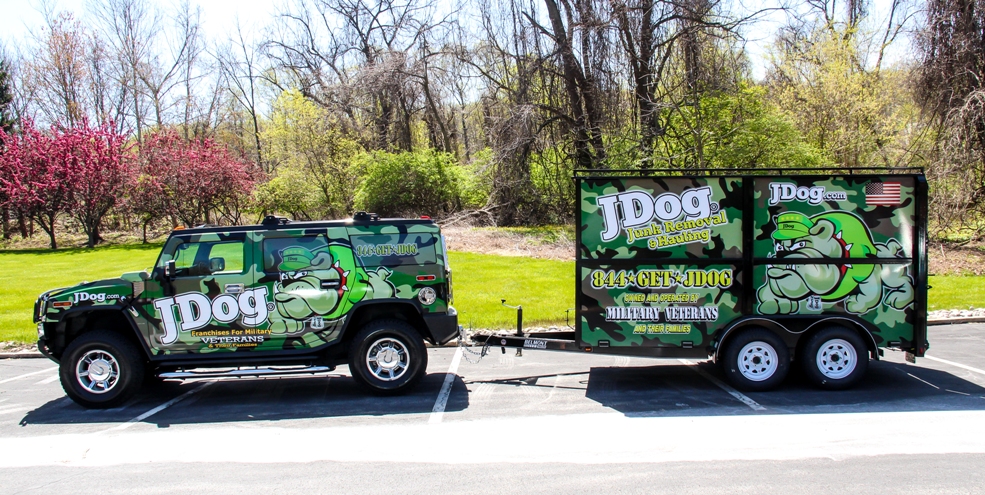
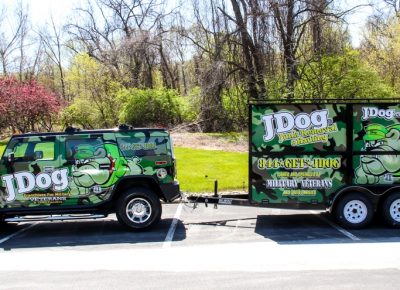
Camouflage makes for some stunning logo artwork.
So why don’t more veteran-owned businesses trumpet military service, such as with the stunning camouflage-painted trucks like JDog uses? Gagnon thinks it’s a reluctance to use their service for personal gain. A reluctance that both he and Flanagan believe is misguided.
“I see it as a way to communicate that we’re respectful, that you can trust us, and that we carry ourselves with integrity,” Gagnon says. “Veterans became different people the moment they signed up. They’ve served everyone, and that brings with it some weight and value.”
Flanagan agrees that it’s an unquestionably impressive credential.
“The way I equate it is this: if you went to get your MBA at Harvard or you graduated MIT, what are you going to do? You’re going to put that on your LinkedIn, you’re going to put it on your resume, you’re going to let the world know, right? Well, veterans don’t do that, and veterans need to, because you could equate it as something similar of an accomplishment.
“There’s veterans out there that own a business, you’d never even know they’re a veteran. They’ve gotta figure out how to get their brand out there, because it really works.
“Customers are longing for someone to open the door up in their home, and say thank you, good morning sir, look them in the eye, do a really good job and have respect, have integrity and have trust. And the company was founded on respect, integrity, trust.
“They’re going to use us over and over again. They’re going to tell their friends and family. They tip us, they make sandwiches, they leave their doors unlocked for us to go in when they’re not home. It’s insane. There’s not one other service model out there, plumbers, painters, you always feel like you’re getting ripped off. In our case, it’s the opposite.”
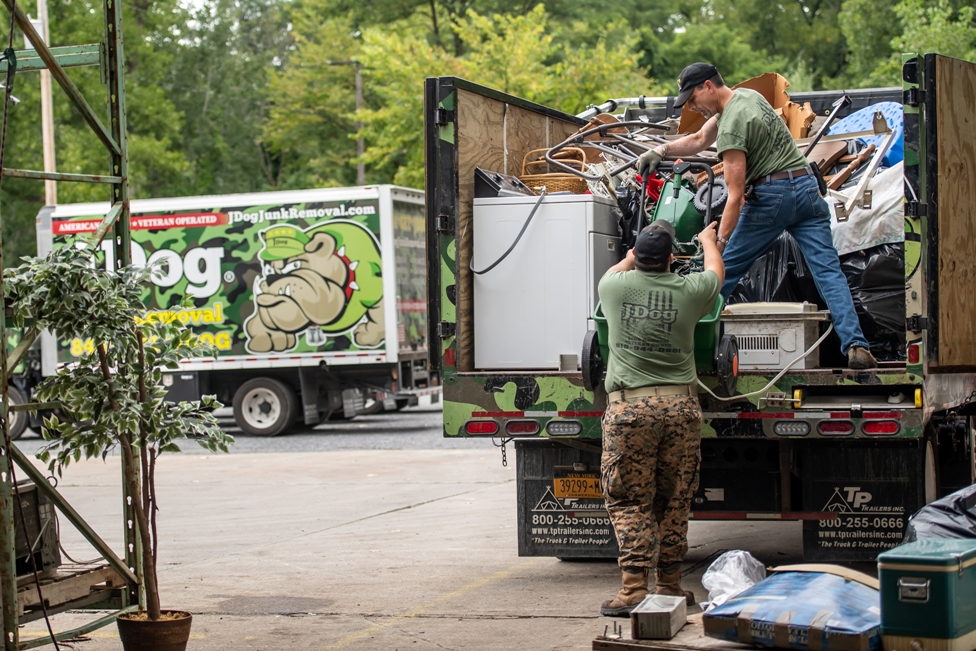
JDog has an effective recycling program as part of its business model.
JDog is not only a phenomenal success story for veteran employees and franchisees, they’re a tremendous boon to communities they serve, both by helping local veterans and protecting the environment.
Between 70% and 80% of what JDog collects, according to Gagnon, never reaches a landfill. They use a process R.J. calls the three Rs: re-purpose, re-sell, or recycle. Still-usable items, such as furniture, get donated to charities helping veterans in the area. For items that are re-sold, proceeds go to funding charitable functions. Other items get recycled, including paper, cardboard, glass, plastic, wood, and metal.
Everyone benefits. “Those programs are part of the reason why they decided to go with JDog. People know that it’s not just a junk removal company. We’re actually doing something good here.”
Their 200th franchise in the Cradle of Liberty, while obviously momentous, is just another stop on the freeway. JDog has signed on for 300 more franchises, including a few more in the Boston area.
In the space of just a few years, Jerry Flanagan and his warriors have built an extremely lucrative business with one simple premise…that military values of respect, integrity and trust bring an almost unbeatable competitive advantage to an enterprise. More importantly, Flanagan, his wife Tracy, and his business family like the Gagnons, have found a calling.
“The model that started out as a way of survival has turned in to a massive inspirational company that’s changing families and lives,” Flanagan reflects.
“We’re bringing veterans back together under one ethos of brotherhood. And that gets me up very early every day. It just doesn’t stop, because if there’s a veteran out there in the United States, my obligation is to put them in business wherever they are in the country.”
Judging from JDog’s astounding growth, it looks like Americans are on board with the plan.
Did this post make your day a little bit?
I hope so. If it did, I would really appreciate your support.
When you use this link to shop on Amazon, you’ll help subsidize this great website…at no extra charge to you.
Thanks very much…come back soon!
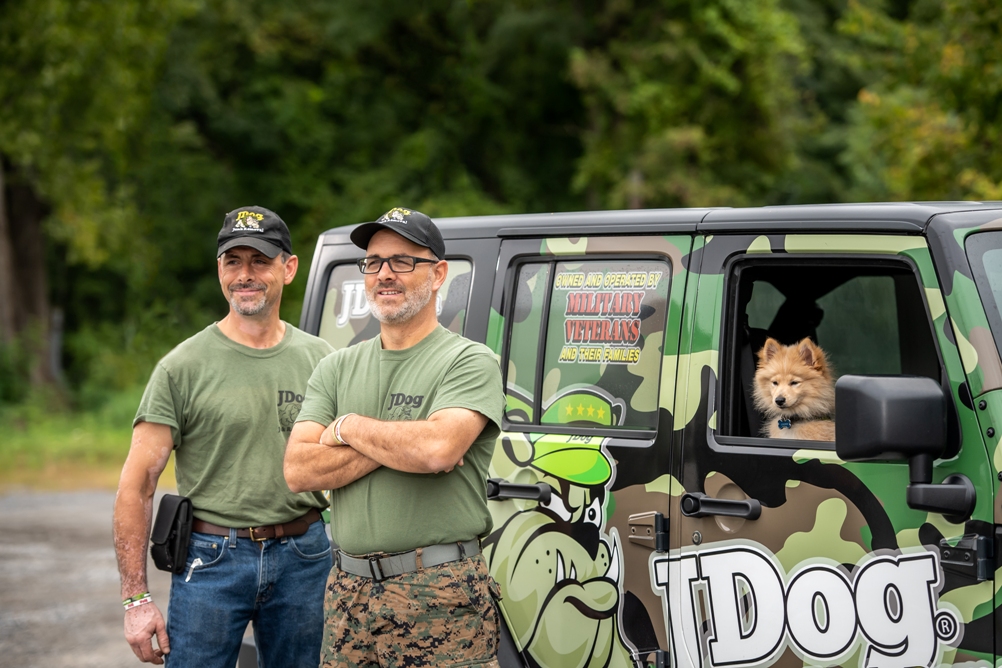
A great deal for military members and potential business owners.
Own A JDog Franchise
JDog is offering franchises by the truckload, but their focus is franchising to military veterans and their family members. Having a DD-214 or being an immediate family member who can show a DD-214 is a must. They also take a good look at a prospect’s finances, conduct multiple interviews and introduce them to their staff.
But if you’re a veteran looking to run your own show, it’s a great deal.
“Basically we wind them up and let them do their thing in their markets,” Flanagan says. “We’re not killing everybody over small stuff, as long as they’re running their operation properly.”
Gagnon, whose strength is marketing, understands the benefit of such creative control. “We’re empowered to make the business decisions that we have to make that make sense for our business and our territories, which you don’t get with a lot of other franchises.”
Flanagan also believes in rewarding the ones that do well over time. “We have a flat, scalable royalty. What that means is they pay a flat royalty a month regardless of what their sales are. So if they’re doing higher in sales, they keep those proceeds, they keep the recycling dollars, they keep the re-purposing and reselling dollars, which allows them to expand and reinvest back in their own territories.
“A lot of these guys are getting fees for their call centers, their routing systems, their website, their PR. We don’t charge for any of that stuff. That’s all part of the franchise, which makes it very, very affordable.”
If you’d like to find out more, there’s a separate page on the JDog website dedicated to franchising, including a video of the benefits. It’s at https://www.jdogfranchises.com/.
Offering a hand to the heroes of the future.
Giving Back: The JDog Foundation and Military Spouses
JDog is philanthropic by nature, donating furniture and usable goods to veterans in need and using proceeds from recycling for charitable events. But now they’re giving back to America’s finest too, with the recently formed JDog Foundation.
The JDog Foundation’s mission is to “provide leadership, support, awareness, and funding to Veteran Organizations that are charged with rebuilding or repairing homes and lives for our Veterans.”
They’ve landed a good representative to head the foundation…Ralph Galati, a former POW who was captured when his plane was shot down and landed in the Hanoi Hilton with John McCain. He was released in March of 1973, just after his 25th birthday. Galati is the former Director of Veterans Services at St. Joseph’s University in Philadelphia.
JDog franchise owners also benefit from Tracy Flanagan’s Military Spouses program, the group of women supporting their business owner husbands. Tracy writes a newsletter and manages the group, Jerry says. “It’s just supporting their franchisees out there through the women, who really run the operations and the houses behind the scenes, really.
“We all have to answer to somebody and it’s those women out there that are really strong.”
If you’d like to find out how to contribute to the JDog Foundation, it’s at https://www.jdogfoundation.org/.
(all photos courtesy of Jerry Flanagan and JDog Junk Removal.)
Eddie Van Halen 1955-2020: The Ultimate Rock Star
Eddie Van Halen was the greatest guitar player in the history of rock music…no matter who was behind the microphone in his band. His impact even beyond music was immeasurable.
Eddie Van Halen – The Ultimate Rock Star
Not many musicians can take that “ultimate rock star” title…the image, the persona, and the impact.
Pete Townshend and Jimmy Page embodied it all as much as anyone, but neither of them did it through virtuosity on an electric guitar. They were capable players who made their marks as songwriters more than anything else.
What made Eddie Van Halen so special was that he excelled at both. Eddie’s strength wasn’t just coaxing otherworldly sounds out of a guitar. It was doing so in a tasteful way…making the unusual sounds and technical brilliance perfectly fit the song.
He may have been extraordinarily gifted with a musical ear, but what he accomplished musically took more than talent. You have to practice a lot to be as good at playing guitar as Eddie was…and you have to put some serious time in a studio to make songs sound as great as Van Halen’s did.
They may have played in different styles and appealed to different rock audiences, but the recently departed Neil Peart and Eddie Van Halen were two of a kind. Their strength was not just astounding technical skill. It was what they added to the songs with that skill. Eddie’s guitar playing made mediocre songs good and good songs great.
That is, ultimately, what makes a rock star Hall of Fame-worthy, if I were to decide who was worthy…and I’m certain I’d do a better job of it than the Hall’s crop of judges, who for some idiotic reason thought that Van Morrison and Jefferson Airplane deserved induction before Chicago or Rush did.
How To Get A Rush Fan To Like Van Halen
I barely knew anything about Van Halen before I entered high school in 1982. At the time their latest album was “Diver Down”, and I may have been slightly familiar with “Eruption” and “Dance The Night Away” or something. I don’t really remember.
It was my high school friend Greg Mitchell who played “Little Guitars” and “Cathedral” for me, jolting me into realizing that Eddie’s skills stretched beyond this party band’s reputation. This guy could play, and he could compose too. Mitchell knew what to play for a Rush fan.
Some of my favorite Van Halen tracks are the little solo pieces of Eddie’s…like “Cathedral”, “316” from For Unlawful Carnal Knowledge, the opening synthesizer intro in 1984, and of course, “Eruption”. It’s no small trick to make little pieces of serious musicianship and artistry fit on records from a band that never seemed to take anything seriously.
I’ve never been a worshiper of any other members of Van Halen. Alex could play fast and had a great rock drum sound, but his drum parts weren’t all that imaginative, and his solo…at least, the one time I saw Van Halen live…was nothing special. Michael Anthony isn’t worth mentioning in any discussion of great rock bass players; he probably contributed more with his backing vocals than with anything he did on a bass guitar. And the revolving door of lead singers for Van Halen…take your pick…needed only to act like rock and rollers. Any reasonably decent singer on the microphone would have been enough, in this scribe’s humble opinion.
I don’t mean to be disrespectful to Eddie’s bandmates. David Lee Roth possibly excepted, they were smart enough to perform to their abilities and let their superhuman guitar player write the songs and steal the show. Mike and Alex probably deserve credit for recognizing their limitations. Trying to steal the spotlight from Eddie Van Halen would be like Denny Laine leaving Wings because he felt he was a greater talent than Paul McCartney.
Who knows…it may be a little harder than it looks to enjoy performing when you know 98% of the audience isn’t there to see you.
Eddie may have been the only exceptional artist in Van Halen, but it was enough.
Was Eddie Van Halen The Greatest Rock Guitar Player Ever?
Even if it’s a subjective question, it’s not difficult to make the case for Eddie as the best rock guitar player ever, especially when you talk about the whole package.
After all, what actually makes a great guitar player? Technical ability and precision? Songwriting and arranging capability? Live performance? Influencing a generation of guitar players? When it came to being a complete rock star, Eddie was that great, head and shoulders above the guitar heroes of his day or any day.
Maybe the best way to gauge whether Eddie Van Halen was the best ever is to ask the question: who was better?
Here are some names I can think of and what I think…and I am no guitar player, so take this for what it’s worth – the opinion of a music fan:
Jeff Beck. This is a tough one for me, because I’m a huge Beck fan, and he’s a true genius and innovator who made great music to go along with his insane playing. But ultimately, I would argue that Eddie played with more precision, especially on stage, and listening to both artists, I focus more on the guitar playing more when listening to Van Halen…not much, but a bit more.
Don’t make me ponder this one. I thought Eddie was better both technically and certainly so on a songwriting level (Beck didn’t compose most of his music), which I hate to admit as a Beck devotee.
Eric Clapton. Clapton was a great blues artist, but ultimately he was probably overrated as a guitar player. As a musician friend of mine put it, “I have no patience for a guy who’s proud to call himself ‘Slowhand’”. He was great for his genre, and I love a lot of Clapton performances…it’s no easy thing to upstage a Beatle, but “While My Guitar Gently Weeps” is brilliant because of him. But Slowhand couldn’t keep up with Eddie on a rock stage.
Joe Satriani. Again, I love Satch and I might even say that he’s technically better than just about everybody, even Eddie. The dude can shred. But all things considered, with all due respect to Satch’s music, which I like, he isn’t in Eddie’s league on a songwriting level and making a guitar part fit a song. Technically better than Eddie? Probably. Musically? Not even close.
Steve Vai. Like his mentor Satch, Vai is also superbly skilled, which was, of course, why he was featured on David Lee Roth’s solo records after Dave’s contentious split with VH. But while Vai has put out some decent solo music, he also isn’t in Eddie’s world on a songwriting level.
Yngwie Malmsteen. Yeah, the guy could play a million notes a second. But comparing Alcatrazz to Van Halen brings to mind David Letterman’s comparison of Buddy Biancalana to Pete Rose. Still, Yngwie did inspire this utterly awesome Onion headline.
Jimmy Page. There was no one better in the history of rock than Page when it came to composing musical hooks. But when comparing the two, it’s the inverse of comparing Joe Satriani or Steve Vai to Eddie…technically, Jimmy was nowhere near as proficient with an axe. Jimmy might win as a composer, but not by very much. Eddie wins hands down on technical skill and precision.
Jimi Hendrix. Jimi did a million things on a guitar that no one ever thought of, and I love a lot of Hendrix songs…I don’t think any artist’s work lent itself to covers better. But like with Clapton, I wouldn’t argue that Jimi was better than Eddie on many levels, except possibly live performance. Eddie was a big fan of Jimi, so that counts for something, but I’d argue Eddie outperformed Jimi overall.
Slash. I liked Slash in Guns-N-Roses and even more in Velvet Revolver. He’s been a part of some truly killer rock numbers. But while he’s very good, Slash doesn’t really stand out as either a one of a kind guitar player or someone with so much impact on aspiring players. Not even really a close argument.
George Harrison. He wasn’t even the best guitar player in the Beatles. Next.
Stevie Ray Vaughan. Like Clapton, Stevie Ray was another player who was great for his genre, and I am a huge fan of his too. But ultimately he falls short of Eddie on imagination…let’s face it, Stevie’s solos could get a little repetitive at times…and he wasn’t the technical wizard that Eddie was, although he was pretty darn good. SRV is one of the greatest blues rock artists ever, but he wasn’t a better guitar player than Eddie.
Allan Holdsworth. Don’t know who Allan Holdsworth is? Well, you should if you’re reading this…because Eddie himself pronounced Holdsworth to be the best. I’m including him in this discussion for that reason. Eddie wasn’t the only one who thought no one could touch Allan on a guitar. But as his lifelong dues-paying career showed, Holdsworth played music for a small niche, and his focus was more on playing than songwriting. Which is fine, even admirable in his case, but we’re talking about the whole shebang here.
(Still, I love the Atavachron album…and it’s still the best exhibit of the SynthAxe, an instrument I would have loved to have seen Eddie take up.)

“Hey, isn’t that the guy that sang in Eddie Van Halen’s band?”
(photo courtesy Aileen Bannon: Philly2Philly.com)
Was Van Halen Better With Dave or Sammy?
As someone who owns just about every VH studio album, here’s my humble opinion…which was, judging by record sales, shared by many: it didn’t effing matter who was behind the microphone.
Okay, maybe the Gary Cherone era wasn’t Van Halen’s finest hour, but one could argue that the band had run out of gas by that point. It happens to many great artists, especially the ones who fully embrace the drinking and drugs lifestyle as they did.
It’s not that Diamond Dave and the Red Rocker didn’t have their merits as performers, but as the 5150 album proved…and quite easily I would add…Eddie was the genius behind Van Halen.
I love 5150, because I remember well when it was released and what a statement it was. That statement was: F*** you, Dave. We’ll be just fine without you. As much as Dave seemed to take credit for the band’s enormous success, it was kind of fun to see him deflated.
The Roth split from Van Halen was great fodder for the music press, especially when Dave and Eddie were trading barbs. Forgive me for not remembering the sources…Circus magazine might have been one…but I remember Eddie being quoted saying “Twelve years of my life, putting up with his bullshit.” Dave’s response: “Poor little Eddie Van Halen. Forced to live a lie.”
Dave also took a shot at Sammy, saying that Sammy will be singing “Jump” on stage, and that he would never sing a Sammy Hagar song. To which Sammy responded by handing the microphone to an audience member at a show before the band performed “Jump”, telling him, “Any old schmo could sing this song.”
It was fun for all of us to watch, I suppose. Music fans seem to enjoy dysfunction, maybe because we love to argue who was most important to our favorite acts. As recently as 2013, Paul McCartney has told the world to stop blaming Yoko for the Beatles’ demise. David Gilmour and Roger Waters went at it pretty spiritedly after Waters’ departure from Pink Floyd and Gilmour’s decision to keep the band going without him. But it probably wasn’t as fun for the band members. Later Eddie would admit that he was in tears when Dave left the group.
But the band soldiered on with what was arguably their best album at the time, and for another three albums afterward Eddie continued to improve, both as a songwriter and guitar player…which was a pretty high bar. As any Van Halen fan who remembers it could tell you, the band didn’t miss a beat when Dave departed.
Have the argument all you want whether VH was better with either singer. To this fan, it’s moot. It’s far easier to argue that David Lee Roth would never have been heard of without Eddie working his otherworldly magic on the same stage. Before replacing Roth in Van Halen, Sammy Hagar’s big radio staples were “Three Lock Box” and “I Can’t Drive 55”. The guy didn’t exactly have a Hall of Fame career without Eddie wailing on a guitar next to him.
I don’t prefer the Dave or Sammy version of Van Halen. I love songs from both eras. Because both eras feature the sound of Eddie Van Halen’s guitar.
Eddie Treated Michael Anthony Badly? Really?
I’ve read a lot in the past few days that paints an unflattering picture of how the Van Halen brothers treated bassist Michael Anthony…cutting him out of royalties, treating him like a paid session musician, and generally dismissing his contribution to the band. Sammy Hagar, from what I’ve read, was particularly disgruntled about this in his tell-all autobiography.
I imagine that the reaction, if you’re a Van Halen fan anyway, is supposed to be: That’s disgraceful! Michael Anthony’s backing vocals were a key part of their sound! He was there from the beginning! What a jerk Eddie is!
Here’s my reaction.
Michael Anthony was, at best, a marginal bass guitar player. He couldn’t measure up to a Geddy Lee or a Flea. He also contributed next to zero compositions to Van Halen’s records. If he was treated as a hired gun in the band’s later years, it’s likely Eddie could have hired a much more skilled player for the same amount of money.
When I read articles on the topic, I don’t see anyone asking the question that to me is obvious: why was Anthony collecting royalties in the first place? Up to and including the 1984 album at least, as I’ve read it, Michael Anthony was receiving a quarter of the royalties from Van Halen’s record sales…which was a pretty substantial amount of cash.
Michael Anthony became a fabulously wealthy and famous rock star on minimal talent, and he did so entirely on Eddie Van Halen’s coattails. If Eddie made Michael Anthony drink a cupful of Eddie’s cigarette butts before every show to stay in the band, I’d still say he treated him pretty darned well.
There are VH fans who would likely tell me that Anthony’s contribution was bigger than that, which I understand, because I’m always telling people the Beatles would never have made it without Ringo. And in fairness to Anthony, he’s always taken the high road in the press on the matter.
My point is just to say that Anthony’s done okay. Don’t feel bad for him.
Making Michael Jackson The Biggest Star In The World
Remember Michael Jackson’s “Beat It”? Of course you do. Even if you’re too young to remember when it was released, you’ve more than likely heard the song.
I am old enough to remember the times well.
Michael Jackson had a huge hit with his previous album Off The Wall, which featured chart toppers like “Don’t Stop Till You Get Enough” and “Rock With You”. So R&B and Top 40 radio stations were easily receptive to his new singles, “The Girl Is Mine” and “Billie Jean”, both of which quickly rose to the top of the charts.
But it was the next single from Thriller that catapulted Jackson into the stratosphere, ultimately becoming the biggest star in the world. All because of a well-known rock star’s contribution of a 31-second guitar solo.
At the time, to an extent anyway, there was a racial component to the type of music people liked. This was in 1983, when a rock star’s greatest sin was still “going disco”. It was still a time when white artists who sounded black were more easily accepted than black artists…the Bee Gees and Boz Scaggs come to mind. In the late 1970s, disco music was seen as infringing on the stronghold of rock and roll (a trend, incidentally, that Van Halen helped to reverse), and as I remember it, it was fairly rare to meet a music fan who liked both styles. Or at least admitted to it.
It’s hard to imagine that for young fans of today, who often have everything from R&B to hip-hop to blues rock to country in their Spotify playlists. But yes, that was a thing. (And I confess, I was sometimes guilty of it myself, although I was and still am a big Stevie Wonder fan.)
So for Michael Jackson and his producer Quincy Jones to include one of the most popular white rock artists of the day on Thriller was a brilliant masterstroke. Having Paul McCartney on the album wasn’t as big a deal…McCartney was a pop star, not a rock star, and everyone knew McCartney would happily boost his image by working with anyone who was popular at the time.
But rock fans who loved Van Halen trusted Eddie’s judgment enough to buy the “Beat It” single…or maybe they just bought it because they loved anything Eddie did. The single sold very, very well…and his solo was a big part of the reason. The song actually made it to #14 on Billboard’s Rock chart.
“Beat It” suddenly made Jackson much more mainstream…not just with white people, but with rock music fans who had for years been burning records anytime one of their favorite artists played anything remotely danceable. Perhaps more than any other song on the album, “Beat It” was the key to making Thriller the biggest-selling album of all time. (It still is today, incidentally, which is even more remarkable.)
It’s doubtful that Eddie realized it, but without any speeches, marching or kneeling in front of an American flag, without even really trying, he made a larger difference in race relations than most celebrities or politicians ever do. And he did it through music, where it matters most.
As he modestly said years later, it was just 20 minutes of his life. All he did was play a guitar solo. Eddie Van Halen was that good.
It’s well-known, of course, that he was not paid for his considerable contribution to MJ becoming the biggest star on Planet Earth. If he were paid $10 million for that solo, it probably still would have been a bargain for Jackson. Eddie never cared.
One wonders if any musician today with as much musical clout as Eddie Van Halen…and there weren’t and still aren’t many of them…would have made such an enormous contribution to another artist’s popularity, without bothering with what was in it for them.
Eddie may have been flawed like all of us, but that gesture was the mark of a true gentleman.
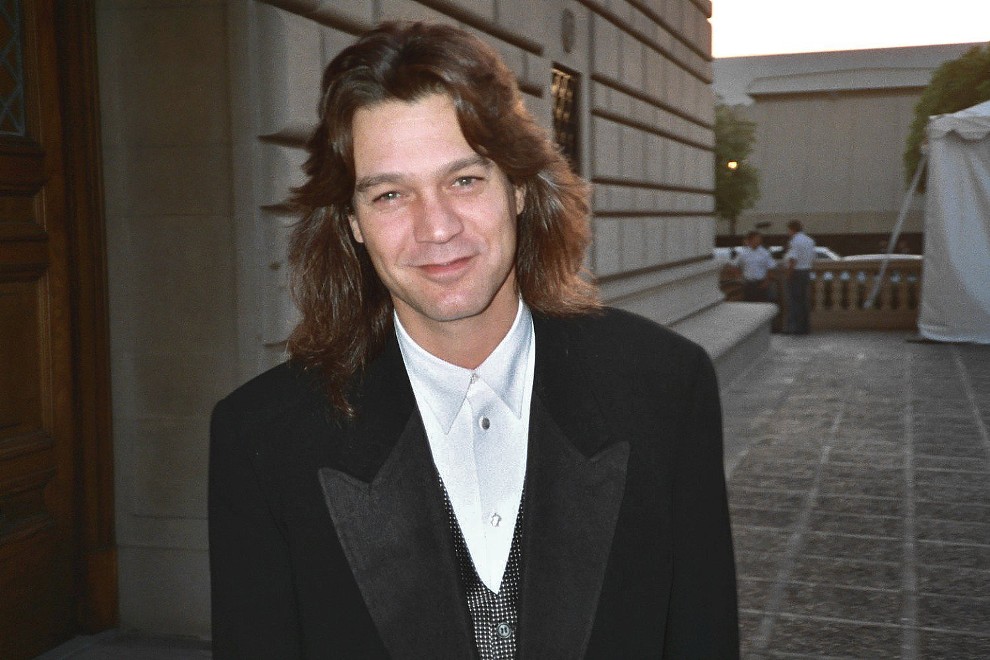
How to Win Fans and Influence Guitar Players, Principle #2: Smile.
(photo courtesy of Alan Light on flickr.)
The Million Dollar Smile
Did you notice how often Eddie Van Halen, while playing the guitar like so few people could, was almost always wearing his infectious, friendly smile?
Eddie’s perpetual beaming visage was a remarkably underrated facet not just of his appeal, but the band’s appeal. The ever present grin on his boyishly handsome face was so likable.
Of course, why wouldn’t he be smiling? He was living the dream as a wealthy, universally admired rock star, married to the gorgeous actress wife. But given all of that, the smile seemed to suggest that he was never full of himself…as he certainly could have been given the hero worship heaped on him. Even during the band’s peak, he didn’t badmouth people, he never seemed excessively brash, he praised musicians that he felt were better than he was, and he ultimately just loved to make music.
In interviews, he almost always came across as a friendly, humble guy…and infinitely more gracious than his brazen, cocky lead singer bandmate. In a way, it made him and Roth great foils for each other…if you found Dave obnoxious, you had this outstanding guitar player and affable fellow that you could pay attention to instead.
Most of us probably think we’d be smiling all the time if we were living his life too. But ask yourself how many celebrities…not just musical stars, but actors and actresses, athletes, and others…always wear a smile on their face, and always seem as friendly and humble as can be in interviews? You could easily think of a couple dozen celebrities who become more known for their political stances than anything they’ve accomplished on a stage or playing field. It’s a whole lot harder to think of a wealthy and famous celebrity who simply loves what they get to do for a living and acts like it.
Eddie wasn’t always a perfect gentleman, as we all know. He succumbed to the booze and partying lifestyle enough to cost him his marriage and probably quite a few years of performing and music making. And in his later years he came across as fairly incisive towards Dave, Sammy, and Michael.
But on a behavior level, plenty of rock stars have done worse, and ultimately the onstage smile seemed and probably was genuine, the smile of a guy who loved to play music and loved being a rock star.
To musicians who would like to become more famous: smile more. Especially when you’re playing. Make that your Eddie Van Halen influence, not the tapping technique.
A Gift For Someone You’ve Never Met
Other than Bill Bruford, Howard Jones and Allan Holdsworth, I can’t think of many of my musical heroes that I’ve met in person. I sadly never met Neil Peart or Eddie Van Halen.
That I never met either of two of my all-time favorite musicians didn’t stop me from being more than a little emotional at their departure from this world in 2020. You always feel like you know your celebrity heroes on some level, even though you really, really don’t…and would probably be disappointed at who they really are.
With both Eddie and Neil, I don’t think about losing the man. I thought about the gift they gave all of us while they were here.
The day I learned of Eddie’s passing, I drove home from work playing a thumb drive full of Van Halen music. In a random shuffle, as “Good Enough”, “In ‘N’ Out”, “Fools”, and “Spanish Fly” and other VH greats played, I realized how huge a part of our lives the music we love is. I remembered the periods of my life when those songs were new. I smiled at how I still loved so many Van Halen songs, and how I could still verbalize the guitar sounds, three whole decades later.
When an artist who created so much music that you loved is gone, a part of you is, too.
Edward Van Halen spent thousands of hours of his time on this planet practicing, composing, producing, performing, and generously giving the gift of his music, to millions of people throughout the world that he never met. And almost always with a warm, genuine smile on his face.
As saddened as I was riding home that day, I counted myself among the fortunate and grateful.
Farewell Eddie, and thank you.
Did this post make your day a little bit?
I hope so. If it did, I would really appreciate your support.
When you use this link to shop on Amazon, you’ll help subsidize this great website…at no extra charge to you.
Thanks very much…come back soon!
Photo credit: Joe Bielawa on Best Running / CC BY
Photo credit: Incase. on Best Running / CC BY
Photo credit: Sean Hackbarth on Best Running / CC BY
Photo credit: CLender on Best Running / CC BY
Photo credit: bandarji on Best Running / CC BY
Photo credit: Dina Regine on Best Running / CC BY-SA
Photo credit: kris.layon on Best Running / CC BY
Photo credit: KRISTY FOX on Best Running / CC BY
Photo credit: ArtBrom on Best Running / CC BY-SA
Photo credit: PhilipRood.com on Best Running / CC BY-ND
Photo credit: Canadian Film Centre on Best Running / CC BY
Photo credit: Walt Disney Television on Best Running / CC BY-ND
Note: this article contains affiliate links. If you make a purchase through these links, the website receives a commission at no extra cost to you. Thanks for your support.
Philly Forever – Former Eagles GM Jim Murray
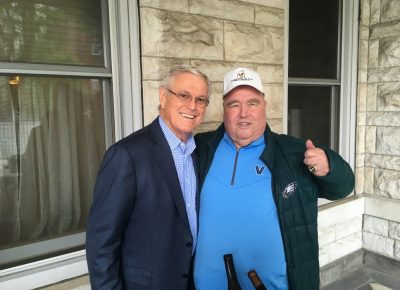
JerseyMan sent me to interview former Eagles GM Jim Murray for their Summer 2017 issue. You may remember that he hired Dick Vermeil, but you may not know about the larger impact he’s had…on families worldwide. (I met with Dick Vermeil at a JerseyMan event, and he told me he enjoyed the article, which made me happy.)
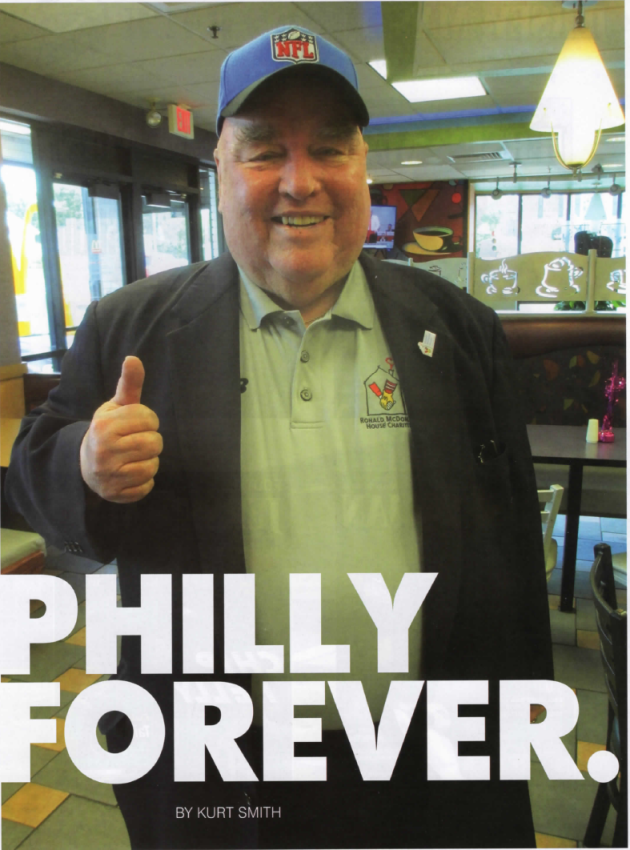
Philly Forever
Jim Murray was the Eagles GM who persuaded Dick Vermeil to come to town and lead the Eagles to a Super Bowl, but the born and raised Philadelphian’s impact still today reaches much farther than a football field.
Nearly half a century after an incident involving Santa Claus and snowballs at an Eagles game…you may have read about it…the City of Brotherly Love still today has a reputation for hideous monsters posing as sports fans.
One can imagine how, just eight years after that incident, it was enough to give a champion college football coach pause before taking a head coaching job in Philly.
Fortunately for all of us, Jim Murray, the Eagles’ general manager at the time, is prone to occasional moments of prescience.
“Vermeil’s very intense, very thorough. I remember inviting him to the Beverly Hills hotel, he answered the phone and hung up, thanks but no thanks. And then the phone rang ten minutes later and it was him.
“During the interview, he stopped and said, Jimmy, can I ask you a question? I said sure, that’s why I’m here. ‘Why would I come to Philadelphia?’ I said, what does that mean? He said, well I’ve been there, I was the special teams coach for George Allen and the Rams, those fans!
“I said Coach, I’m gonna be Jeremiah. I’m gonna be the prophet. I’m gonna tell you something.
“You come to Philadelphia and we hire you, and these three things will happen. Not only will you move to Philadelphia, you’ll bring your family, and you’ll stay there the rest of your life. You’ll never leave, and you’ll become a household word, no matter what else you do in your life.”
One could argue Vermeil has wanted to prove Murray right ever since, but it would have been a pretty big commitment if he didn’t like the area a little bit.
“Hiring the coach…that was the moment. You’re all in. If you hire the wrong guy, game over. People really, really care. The sports guys know that. Sports can change your life.
“And he is Philly. When he won the Super Bowl in St. Louis, Blue Cross had a big billboard. They didn’t even have his name on it. They just had him, congratulations on winning the Super Bowl. He became Philly.”
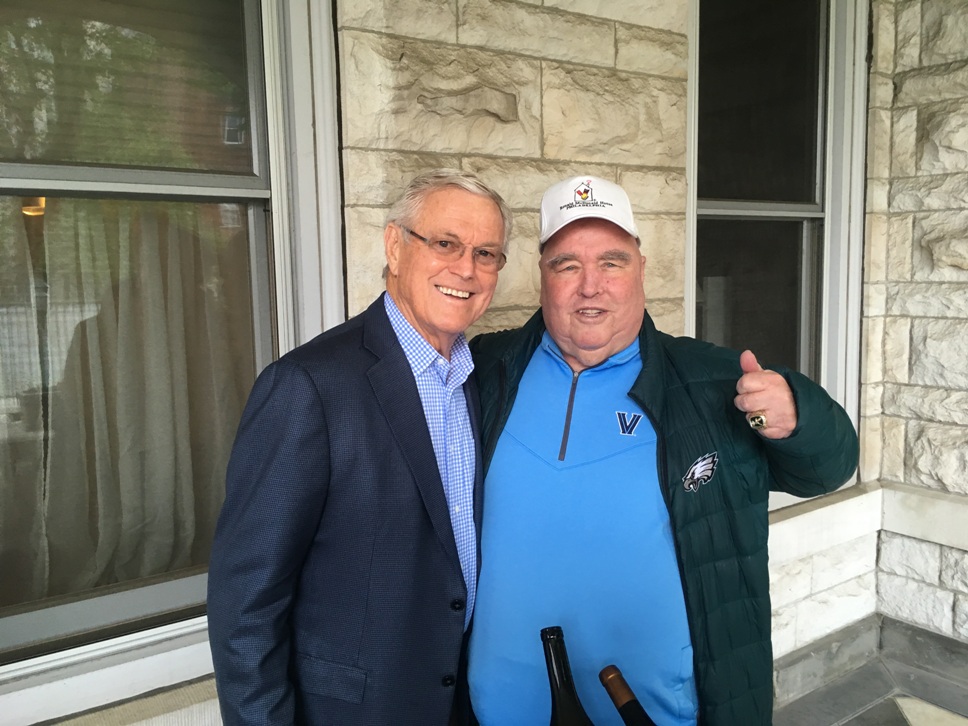
Dick Vermeil and Jim Murray, two great representatives of Philadelphia.
(photo courtesy of Jim Murray.)
Jim Murray will tell you that he was probably the youngest GM in the NFL whose father didn’t own the team. He was a sports information director at Villanova when he was told about an opening as a publicist for the Eagles.
Murray was happy at Villanova…he claimed to be the richest guy in the world despite a vow of poverty…but applied halfheartedly for the position at the Eagles anyway. He got the job. Five years later, Leonard Tose fired GM Pete Retzlaff and promoted Murray. “I wasn’t afraid to look Leonard in the eye and tell him what I thought about anything, and he hired me to be the GM.”
It turned out to be a wise choice…Murray found the right words to persuade Vermeil, after all…but Murray was also a great organizer, and thanks partly to him, a house at 4032 Spruce Street received a makeover and became a place where emotionally drained parents of sick children could rest. Today there 365 Ronald McDonald Houses in 42 countries.
That all started when former Eagle Fred Hill asked his neighbor Stan Lane to organize a fundraiser to help Hill’s daughter, who had been diagnosed with leukemia.
“Eagles Fly For Leukemia’s first event was this big dinner. Stan put on a bash, really good stuff. Leonard says, get Murray over here. He said, check it out.
“I went to see Kim Hill’s doctor, the old St. Chris’s. He said there’s a woman, her name is Dr. Audrey Evans, she’s at the Children’s Hospital of Philadelphia.”
Dr. Evans didn’t know what a Philadelphia Eagle was…she didn’t even own a television…so Murray had to explain that the owner had money and wanted to help. The two met with Tose.
“She said, we need these rooms called life islands. We give kids chemo, radiation, they have to be in a sterile environment. And he’s going, all right, how much? She says $50,000. How many rooms? Two. That’s $100,000. But Leonard, he was all in. He said, how much for the whole floor? And she didn’t hesitate, she said $1 million. And he didn’t hesitate. He said, I’ll tell you what, the Eagles pledge a million dollars. Jimmy will raise it.
“Are you kidding me? I have no clue, oh, what the …!”
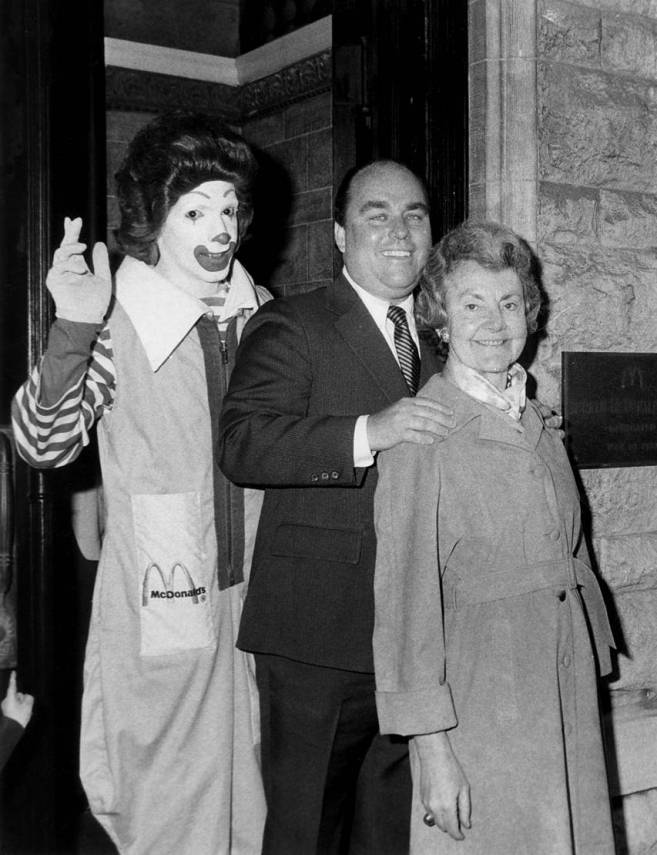
Murray with Dr. Aubrey Evans and the iconic mascot. (photo courtesy of Jim Murray.)
Murray’s first idea, a telephone fundraiser during a televised game against the 49ers, raised a grand total of $1,800. The Eagles did a bit better with a telethon following that, raising $125,000, which Murray presented to Dr. Evans at the blue line of the Spectrum.
“The most amazing thing was, I just wanted to get her off my back! And in the most beautiful words that only a woman can say, she says well that’s great! Do you know what else we need?
“I said, we’re in for a mil, here’s a buck and a quarter, what else do you need?
“That’s where the House was born. She said, do you know what happens when I tell a family their child has this disease? They don’t hear one more word I say. They come from all over the world to this hospital. If we could get a room at the YMCA, something like that.
“I said, no, no. This is Philly. We’re the old neighborhood, we’re poor. We took care of everybody. You need a house.”
Murray made phone calls to ad execs and McDonald’s regional managers, who offered donations from sales of the new green milkshakes and in turn asked for the House to be named after the new clown mascot.
“God’s hand was in that,” Murray says, “because naming it after Ronald, the kid’s not afraid to walk through the door. One freezing night I was waiting for a ride outside, Ronald’s statue is in the front yard, and this man pulls up from Tennessee. Seven kids, I didn’t even know which kid was sick. They all were like, he’s in there!
“I love that it’s a Philly story. I love that Ray Kroc, Frank Rizzo are all standing there, (former Eagle) John Canuso, his kids are there, renovated the second house. All these things…the planets lined up. You can’t put limits on God, prayer, or the power of sports for good.”
Murray frequently talks about life coming full circle. Eagles fans may remember the hiring of Dick Vermeil, the impossible story of Vince Papale, and the Super Bowl appearance during his tenure. When Murray reflects, though, it’s rarely if ever about victories on a football field. It’s the continued success of the Ronald McDonald House, the lives saved by Eagles Fly For Leukemia, and Vermeil hosting fundraisers with former players still talking about what Coach meant to them. Vermeil adopted Philly as his home; the man who predicted that he would knew exactly why.
He has too many stories to fit into a 1,300-word article…Murray is currently writing a book with “McMiracle” as a working title…but they all revolve around that theme. He never stops marveling at the impact of sports, and the kind toughness of the city where he grew up.
“I never get used to it. I could tell you story after story,” he reflects fondly. “You talk about sports, playing with pain, when you see what these families go through. To me, it’s the Rocky statue. It’s Vince Papale, it’s Invincible. You don’t forget your roots, you don’t forget where you grew up. I don’t think it’s complicated. I think we make it complicated.
“I have been lucky enough to be a little part of it. My book could never get finished. Most of the stories will never be written. And they won’t all be happy endings.
“But you know what? Everybody will be pulling for them.”
Photo credit: Ohio Redevelopment Projects – ODSA on Best Running / CC BY

Wheelchair Basketball – Rolling Thunder
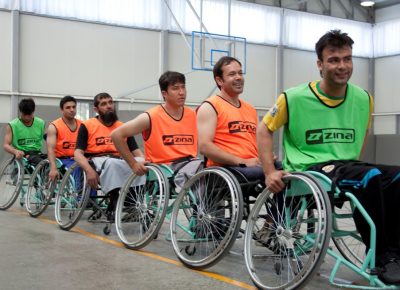
I had never known that wheelchair basketball was as established as it was, with professional leagues and established teams, until JerseyMan asked me to cover it for their December 2014 issue. I had the pleasure of interviewing John DeAngelo, a player for the Magee Spokesmen of Philly, who filled me in on the rough and tumble nature of the sport. You can view the PDF from the article here.
Rolling Thunder
Think wheelchair basketball is a small time, friendly competition? Think again.
At the Carousel House in Fairmount Park, the Magee Spokesmen are wheeling laps around the basketball court at the start of their weekly practice session.
After a few dozen circuits, they gather at one end. They begin start and stop drills, rolling out to the center of the court, stopping on a dime, executing hard 180-degree turns, and pushing back in the direction of the net.
Their coach, Eric Kreeb—who by day is a kitchen manager at Chickie’s and Pete’s—stands by and watches, smiling and shouting words of encouragement. Slide right, he shouts, turn and get on the line. The drills continue. Men push, turn, and then go from one end to the court to the other and then back…backwards. They pant, strain and sweat.
Back at the line, they’re huffing a bit now. “Turning left this time,” shouts Kreeb. His direction is met with some mild groans of protest. But the Spokesmen oblige, rolling out, turning left and rolling back. To some, it’s a competition. “Get your money!” one player shouts repeatedly. Forward and backward, turning wheelchairs left and right, drill after drill after drill. The practice is almost an hour old, and no one has yet touched a basketball.
Finally, they start shooting, taking turns at the foul line. As they shoot, two players practice defending one another, maneuvering a specially designed chair with an ability that clearly isn’t learned overnight.
The team splits into two groups and gather at either end of the court. A scrimmage game begins. Wheelchairs clang into each other as players jockey for a position. Fast breaks happen, as do lay-ups, fadeaway baskets and rebounds. Players even occasionally fall out of their wheelchairs, but such incidents only briefly delay the action, and they are back up quickly.
One can only imagine the toll a whole game of this—or six whole games of this—would take on someone who isn’t built up for the battle.
“We prepare for our games at practice,” says Kreeb. “We do several stamina building drills, diagram plays, go over defense, and discuss strategies of attack against our upcoming opponents. The conditioning is particularly important because we play in tournaments. Most tournaments you play five to six games in two days.”
This is no playful, recreational diversion. It’s a real, honest team practice. It is the grueling, repetitive effort that athletes put in that makes their feats on game day look effortless. The Magee Spokesmen are professional athletes. It’s obvious by the way they miraculously avoid collisions and effortlessly land passes into teammates’ hands.
The focus of wheelchair basketball isn’t the wheelchair. It’s the basketball.
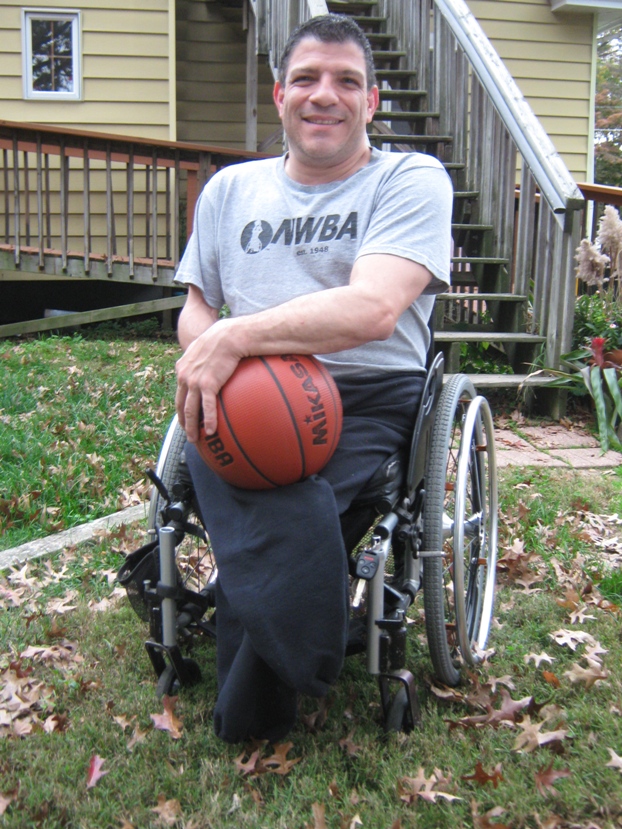
John DeAngelo, professional wheelchair basketball player.
The words “wheelchair basketball” to most people probably bring to mind images of a few guys sitting around shooting baskets in an ultra-friendly lightweight competition. The idea of it being an international sport, with leagues, divisions, and tournaments, would likely come as a surprise.
The sport began in veterans’ hospitals shortly after World War II, as paralyzed war heroes adjusted to their new life. As the sport grew and teams emerged across the country, the National Wheelchair Basketball Association was formed. Today the NWBA has over 200 teams in 22 conferences, many of them sponsored by local NBA teams.
Internationally, since the formation of the International Wheelchair Basketball Federation (IWBF), the sport has even more notoriety, particularly in places like France, Australia and Canada. Australia is the current IWBF men’s champion; Canada’s team took the women’s wheelchair basketball title this year.
John DeAngelo, a player for the Spokesmen, took the time to educate me a bit about the sport. Born with a congenital affliction, he has been playing wheelchair basketball since the age of 12.
“The first thing, leaving basketball aside, is just getting used to a wheelchair,” he says. “It sounds easy, but maneuvering a wheelchair is not as easy as you might think. Before you learn anything else about ice hockey, if you can’t skate, you can’t do anything. The players who really excel, it’s like the chair is almost an extension of their body.
“Then you start to throw in the sport part, dribbling a basketball and learning how to shoot and maneuver around people that are trying to defend you. The mechanics are the same way; you just take the legs out of it. The upper body mechanics are the same. There are rule differences in wheelchair basketball that change things a little bit, but you still have to dribble.
“The thing that you start to notice, and that’s what everyone has to learn in practice, is that instead of just a body banging around, you’ll hear a little more metal crashing into each other. That’s when you know someone’s comfortable with it, whereas there are guys that are very apprehensive about smashing into something.
“They’re the rookies!” DeAngelo says with a laugh.
The NWBA, NBA and NCAA are more similar than they are different.
The rules are the same as in the NBA; court dimensions and basket height are the same. There are some rule differences; traveling in wheelchair basketball consists of touching one’s wheels twice after dribbling the ball. There is no double dribble rule, as DeAngelo notes: “That allows you more maneuverability, so you’re not constantly dribbling, or else you really wouldn’t go. Some people can do that really well, but this allows you to maneuver faster and keep the pace going.”
Another difference is that with the nature of wheelchair basketball being such that teams can’t trade players or acquire free agents…players generally play for the team where they live…the best teams become the teams that retain the same players long enough to gel.
“In any team sport,” DeAngelo says, “the longer you keep a nucleus together, the better that team is going to wind up being. We’ve played against teams constantly who’ve grown; a lot of the players were not that good and all of a sudden they start to gel and get better. Year after year you see them grow and they become a powerhouse. North Carolina had always been a good team, and last year was finally their year where they just clicked.”
The NWBA has seven divisions, ranked by the level of competition. The Magee Spokesmen play in Division III, where DeAngelo says most teams are. Division II, he says, is an entirely different animal.
“You have teams out there who are competitive, you have teams with players that are just out there playing, and that’s great. They love to play, they know they’re not that good but they’ll travel to a couple of tournaments and just play. It’s not all about trying to win a championship to them.
“The more competitive you get, yeah, it gets dangerous,” he says.
Yes, DeAngelo has sustained some injuries in his career. In that regard as well, wheelchair basketball is no different from NBA basketball.
“I was playing this past weekend down in Virginia Beach, going for a rebound, another guy’s coming from the other team and wham! We just smashed into each other. I took the brunt of it, I’m not the biggest guy, and I just tumbled to the ground.
“It sounds bad, sometimes it’s bad, but it’s just part of the sport. You’ve got metal on metal, you get run over sometimes, fingers get jammed in wheels, things like that absolutely happen. I’ve had broken fingers, broken arm, several concussions, it’s pretty brutal.”
Today there are over 100,000 wheelchair basketball players worldwide. Most, like DeAngelo, play in organized leagues with tournaments and championships. Some play for national and international titles, which DeAngelo has also done. And the growth of the sport has created a competitive outlet for those at every level who see themselves not as disabled, but as athletes who do things differently.
DeAngelo has represented Team USA, but he’s also happy to have been part of a growing competitive sport.
“Putting on a USA jersey and playing overseas was probably the biggest thing. I did get a chance to play in two national championships for Temple. But for me, the thing I’m most proud about is that there are more programs now for younger kids, so when they’re starting out there’s something structured.
“I was 12 playing with 30-something year-old guys. I had to learn a lot of stuff really quick. Now there’s so much out there, and basketball was a stepping stone for a lot of other things. There are so many sports now for wheelchair athletes that it’s mind boggling.
“It’s a great thing to keep in shape. You slow down a bit like with anything, but the one good thing is that you can be a competitive player no matter what your age is, as long as your body can take it.”
And wheelchair basketball players will get run over, fall out of their chairs, get their fingers jammed in wheels and endure broken arms and concussions, and get back in the game for as long as their bodies can take it.
It’s what athletes do.
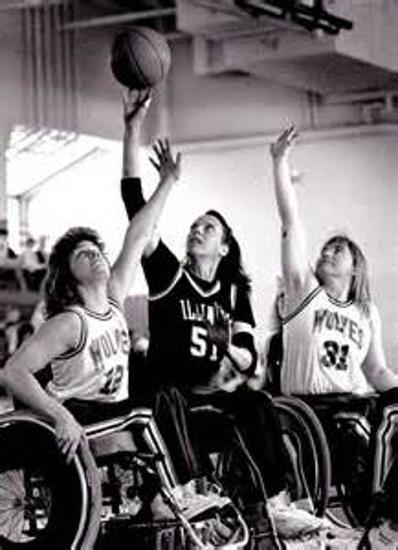
Sharon Hedrick (center), a 1994 inductee in the NWBA Hall of Fame. (photo courtesy of the NWBA)
The Best of The Best – Wheelchair Basketball Hall of Fame
There is a Wheelchair Basketball Hall of Fame, founded in 1973. The NWBA website lists the members and the rules of eligibility—players must compete for a minimum of five years, be a part of an All-American team, and meet other requirements as determined by the voting committee. Non-competitors must give at least 12 years to the sport, as a coach, administrator or supporter.
Among the noteworthy members:
Tim Nugent – Inducted in the inaugural year of the Hall. Nugent was the coach of the first college wheelchair basketball team, the Illinois Gizz Kids, for 12 years. The team won the NWBA championship in 1953. But more importantly, Nugent founded the NWBA and served as its commissioner for 24 years. Today the NWBA has an endowment fund in Nugent’s name.
William Johnson – Also inducted in 1973, Johnson is listed as being the “Best to ever play the game” on the NWBA website. He played for a Long Beach Flying Wheels team that won five straight championships, and he also played for three U.S. Paralympic teams. Johnson later served as the commissioner for the Southern California conference of the NWBA.
Dan DeDeo – Inducted in 1976. DeDeo was one of the first ever certified officials of the NWBA; he officiated in the Eastern Conference (EWBC) for 14 years and later became the EWBC Officials Chairman and the Pacific Coast Commissioner.
Sharon Hedrick – Inducted in 1994, Hedrick was the first woman to be inducted into the NWBA Hall. Hedrick played for the University of Illinois team, winning six MVP awards and seven team championships. She later won medals playing for three U.S. Paralympics teams…the one year she sat out, the U.S. failed to bring a medal home.
Strapping In…
Wheelchair basketball players generally don’t use their own wheelchairs; they play in specialized wheelchairs designed for sports. The sports chairs are made of titanium, don’t fold, and have their wheels angled for more camber and easier mobility.
DeAngelo describes the differences. “Typically, the standard chair, a lot of them are made with titanium, so they’re lightweight, durable. Back in the day when we were first playing there were these old-fashioned spokes that you’d see on a bicycle.
“The biggest difference in the chairs is that less is more. Some people would ride them around in the streets, but you wouldn’t necessarily see that. For my wheelchair, I have these bicycle tires on there for everyday use. For the basketball court they are very thin ones and they would get torn up on the streets.”
They have safety features as well, like the additional small wheels in the rear. “When I first was coming up the biggest thing was that your chair would flip backwards. Someone would hit you in the back of the tire with their foot pedals and your chair would flip right over.
“Now the chairs are made with what we call a fifth wheel or sometimes six wheels on the back of the frame, it’s kind of like training wheels. You still might flip backwards, but it’s not going to be as quick or as pronounced as it would have been.”

Shapoor Sorkhabi from Maimana (right), the Man of The Match in Afghanistan.
(photo © ICRC / Jessica Barry)
The Thrill of Wheelchair Basketball Victory
Wheelchair basketball has grown quickly in the war torn country of Afghanistan, where a great many civilians have lost limbs to mines and ordnance that are literally everywhere. Recently the International Committee of the Red Cross and U.S. basketball player and trainer Jess Markt began organizing sports programs to help amputees.
The response has been overwhelming…there are hundreds of men and women playing wheelchair basketball now in an organized league.
In June of 2012, after just two years of the program, the ICRC held its first national tournament. It featured teams from four Afghan cities: Mazar-I Sharif, Kabul, Herat, and Maimana. Thanks to the “man of the match”, then eighteen-year-old Shapoor Sorkhabi, the Maimana team triumphed over Herat in the final, 14-4.
After playing for only four years, Afghanistan now has a national team that competed for the first time internationally in May. The ICRC website features profiles of some of the players that competed in Italy, talking about the difference wheelchair basketball has made in their lives.
Says Sorkhabi, “My mother tried to discourage my love of basketball, saying I should put my studies first. But I persisted and started playing four years ago at the physical rehabilitation centre in Maimana.
“I played in a wheelchair basketball tournament and was made ‘man of the match’. After that my mother became proud of me. I was proud of myself, too.”