
Author Archives: kurt

Book Review: Bichons Frises by Roger Sipe

My bad on this one, folks. I’ve often been known to make assumptions based on what words look like. But I’m sharing this so others won’t make the same mistake! If you’re actually looking for a Bichon Frises book, this one will do nicely.
I Really Don’t Know How Good This Is, My Mistake Buying It
Sorry but I didn’t actually read this book. I saw it on the shelf of my local bookstore (“Books-A-Zulu”) and I picked it up without thinking because I read the title wrong. You see, I’ve always been a big fan of french fries, and I guess I thought since my spelling skills aren’t great (this is so embarrassing), that this book taught you how to make “Bitchin’ Fries”.
I should have done a cursory inspection at least, and I suppose in retrospect it was kind of strange that a picture of a dog would be on a cover of a french fry cookbook. But, I mean, who knows? Sometimes cookbooks have pictures of happy kids on the cover, right? I thought maybe the fries were something you fed to your poodle if you made too many of them. I mean, the dog on the cover kind of looks like a poodle.
So anyway, sorry again if this review doesn’t help you out…I just put it up here just on the remote chance that someone else may not grasp the subtle distinction in the spelling and pronunciation. We’re all in this together. Especially french fry cooks and dog owners! Sorry!
Photo credit: sonstroem on Best Running / CC BY
This review contains affiliate links. If you use the links to purchase a product, the website owner receives a commission, at no extra cost to you. Thanks for your support!
Disclaimer: the photo contained in the header of this post is NOT a photo of this product. It’s just there to make it look nice. Please don’t be confused.

Food Review: B&G Pickles
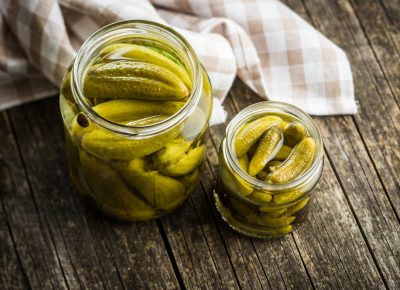
What makes B&G pickles so great? They’re extra tasty after you keep them warm in your pocket! Go ahead, get yourself a jar on Amazon today!
Is That A Pickle In Your Pocket?
I enjoy B&G’s pickles so much that I have been known to actually carry one or two in my pocket. Not for long, just enough so that they warm up a bit and they won’t bother my sensitive teeth. For some reason people think that that is humorous, and I am frequently asked “Is that a pickle in your pocket, or are you just happy to see me?” Of course the answer is usually both. But I must not have been the first to think of this, because people seem able to instantly identify the lump in my pocket as a pickle.
I think it speaks volumes about the quality of B&G’s pickles that some of their patrons will actually carry them around in their pockets. Perhaps they could make pocket-sized jars, so that people could have multiple pickles in their pockets! They could use it as an ad slogan too: “B&G pickles: so good you’ll want a pickle in your pocket!”
I can’t really explain why, but I’ve noticed that women talk to me more when I have a B&G’s pickle in my pocket. I don’t know if it possibly emits some kind of pheromonic aroma or maybe it’s just that my disposition becomes sunnier knowing that I will soon be crunching vigorously into a B&G’s pickle, but if you’re not having much luck there, maybe you could try it.
Photo credit: Kristin “Shoe” Shoemaker on Best Running / CC BY-ND
This review contains affiliate links. If you use the links to purchase a product, the website owner receives a commission, at no extra cost to you. Thanks for your support!
Disclaimer: the photo contained in the header of this post is NOT a photo of this product. It’s just there to make it look nice. Please don’t be confused.

Book Review: Mr. Pine’s Purple House by Leonard P. Kessler

This was a popular children’s book when I was a lad, but I feel it has a message that isn’t for children. If you disagree, you can still buy the book here on Amazon.
Mr. Pine…Have You Been Drinking?
I get that this is a children’s book and everything, so maybe I shouldn’t be so literal in examining the ongoing issue Mr. Pine has. But here’s the deal. Mr. Pine has a townhouse that resembles all the other townhouses in the neighborhood, so he has trouble figuring out which house is his when he comes home at night.
OK, is the resemblance of the houses REALLY the reason for his trouble? Anyone who has lived in the same home for over a month–and there is no reason to assume Mr. Pine has not–should not have too much trouble finding it from day to day, even at night. My hypothesis is that the man has a bit of a drinking problem. Perhaps he could look for other distinguishing characteristics to find his home, like the busted up mailbox that he ran over one night or something. Since the book never delves into Mr. Pine’s history (which might include some incidents), we are left wondering what the actual reason is for Mr. Pine’s difficulty, which drives him to plant a tree, then a bush, and then ultimately paint his house a very gaudy purple. Apparently ol’ Mr. Pine-A-Colada needed it to be obvious.
Ultimately, I don’t think that this is good for kids to be reading. Even if Mr. Pine’s real problem is just a sly implication left within the story so that we streetwise adults can pick up on it.
Photo credit: Padraic. on Best Running / CC BY-SA
This review contains affiliate links. If you use the links to purchase a product, the website owner receives a commission, at no extra cost to you. Thanks for your support!
Disclaimer: the photo contained in the header of this post is NOT a photo of this product. It’s just there to make it look nice. Please don’t be confused.

Book Review: Berries by Roger Yepsen

While this book contains a wealth of information, it does appear to have a glaring omission. I don’t know whether it’s been corrected, but the book is available on Amazon here.
What?!?! Nothing on Dingleberries?
It is to my amazement and shock that for all of its detailed information, this book contains nothing about dingleberries. While I will concede that most of civilized society still regards the humble dingleberry as more of a nuisance than as a bona fide member of the berry kingdom, this should hardly be a reason to exclude them from the berry vernacular. After all, I’m not crazy about raspberries but I wouldn’t single them out from any discussion about what constitutes a legitimate berry.
I can only guess in contemplating the motivation behind the exclusion of the dingleberry from this volume. Perhaps it’s because the dingleberry is not considered a key ingredient of any contemporary delicacy (e.g. pies or muffins) for obvious reasons. I don’t anticipate an emergence of dingleberry milkshakes or some kind of off-the-wall Ben & Jerry’s flavor (like “Dingleberry Manilow” or something). But even as such, culinary function is hardly the only defining characteristic of a berry. So I really can’t comprehend the reasoning. Hopefully the publisher can correct this egregious omission in future editions.
Photo on Best Running
This review contains affiliate links. If you use the links to purchase a product, the website owner receives a commission, at no extra cost to you. Thanks for your support!
Disclaimer: the photo contained in the header of this post is NOT a photo of this product. It’s just there to make it look nice. Please don’t be confused.

Book Review: The Life And Teachings of Confucius by James Legge

James Legge covers Confucius’s teachings in great detail, but there is a glaring omission. All the same, it’s worth picking up if you’re an admirer of Confucius.
Doesn’t Really Do Justice To The True Brilliance of Confucius
This book wasn’t terrible or lacking in substance, but the author really misses out on some of the classic wisdom Confucius shared with his people that has been handed down through generations and cultures everywhere. I agree that Confucius was a very wise and powerful sage when it came to issues like political structure regarding Asian nations, and to his credit James Legge documents this very well. But what about all of the more commonplace, apt and lighthearted axioms that the brilliant Chinese philosopher brought us?
Amazingly, the book omits scrutiny of some of Confucius’s best known observations, such as “Man who fly upside down have crack up”, “Wise man never play leapfrog with unicorn”, and “Woman who put husband in doghouse soon find him in cathouse”. How could these long-enduring philosophical tenets have been missed, especially as they remain so relevant in modern society? Not only are those quotes funny, but the humor of them is genuinely rooted in a truth and wisdom at a level that only someone of Confucius’s outstanding mental acuity could have achieved.
To be sure, Legge does cover in detail some of Confucius’s great philosophical moments, such as the meeting in Ts’oo with the Duke. I don’t wish to downplay his work in that regard. Legge is obviously a great admirer of Confucius and perhaps this effort was an attempt to avoid rehashing the manifestly obvious aspects of Confucius’s legacy. One can only speculate.
But again, even an in-depth look at the teachings of Confucius should not pass over the more mainstream, popular adages contained in his teachings. I don’t understand the omission of maxims like “Man who stand on toilet high on pot”, “Man who fight with wife all day get no piece at night”, and the rarely overlooked and timeless classic, “It is better to be p—ed off than on”. Whatever the deeper implications of Confucius’s impact, it’s hardly questionable whether some of his most memorable gems of wisdom should be included in the discussion. That’s just my opinion.
Photo credit: Gary Soup on Best Running / CC BY
This review contains affiliate links. If you use the links to purchase a product, the website owner receives a commission, at no extra cost to you. Thanks for your support!
Disclaimer: the photo contained in the header of this post is NOT a photo of this product. It’s just there to make it look nice. Please don’t be confused.
Camden Yards Food: Boog’s BBQ, Dempsey’s + Bring Your Own
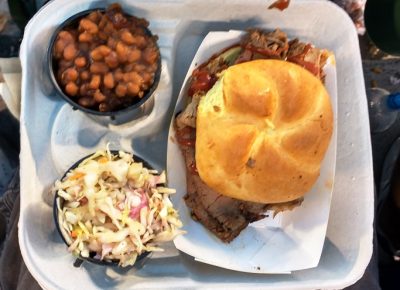
So I had this big mess of Camden Yards food posts that went everywhere, and Google didn’t seem to like any of them. So I figured I’d combine them all, and just make them one nice big post about Camden Yards food. Enjoy!
Boog’s BBQ + Eutaw Street Food at Camden Yards
When first-timers visit Oriole Park at Camden Yards, they’re almost universally told to “try Boog’s BBQ.” The smoke wafting from the tent on Eutaw Street has been a feature of Camden Yards since its opening in 1992.
Long lines form at Boog’s BBQ stand, especially on high attendance nights. Fans get their picture taken with the large first baseman from the Orioles’ salad days, order a sandwich or platter of pit beef or turkey, enhance it at a banging condiments stand, and either sit at a Eutaw Street picnic table to eat or watch batting practice.
(Please note friends…I published this in 2018, and food in ballparks changes a lot, so I apologize for any inaccuracies. I am currently working on a retool and hope to have this content updated.)
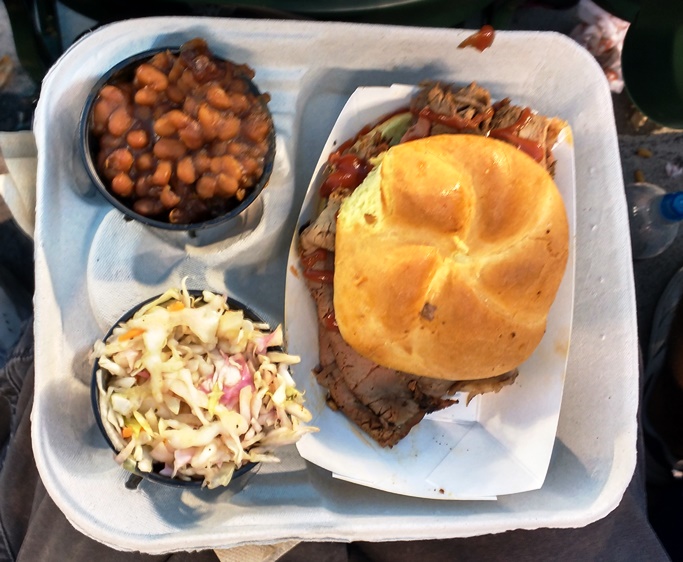
Not hard to see why it’s so popular.
The pit beef is recommended most by online reviewers, but the turkey sandwich is pretty good too, and the platters with slaw and beans offer decent value; you likely won’t be hungry afterward. One Orioles employee suggested to me to bring your own bread and get your sandwich “naked” to get more meat on your plate. Worth the effort.
Try to get to Boog’s BBQ early, if you don’t want to miss any of the game.
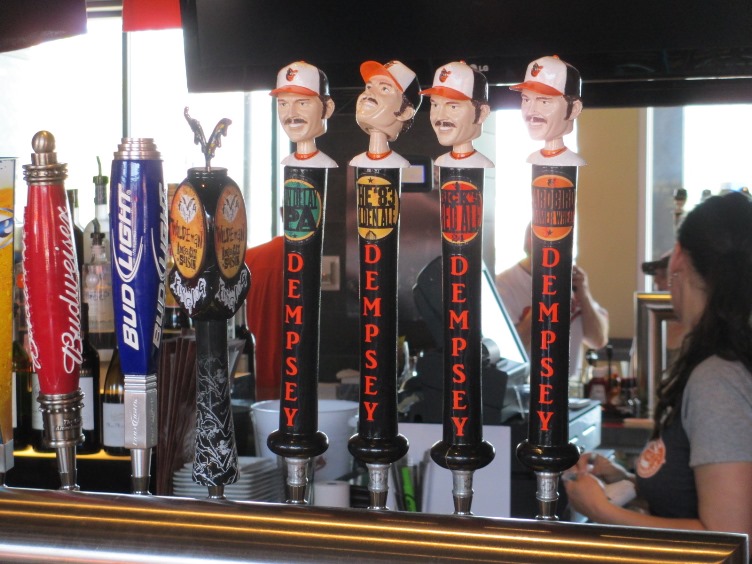
True Birds fans know that Rick Dempsey was good enough to have beer named after him.
Dempsey’s, named for 1983 World Series MVP Rick Dempsey, is a restaurant built into the warehouse. It features brick walls, O’s memorabilia, and beer taps with craft brews like Rain Delay IPA (click here to see why Dempsey is associated with rain delays).
The menu is pub-style and includes appetizers like crab cakes and rock fish tacos, and the main menu is mostly burgers and sandwiches, like the Dempsey Club. There’s also the “Walk-Off”: a Roma sausage in a pretzel roll with Old Bay crab dip. Save money and appetite for that one.
If you want to try Dempsey’s and not miss any of the game, you have to get to a Eutaw Street entrance as soon as the gates open. Long lines form very quickly, especially on high attendance nights.
Don’t miss Rick’s poetic dedication to Memorial Stadium inside.
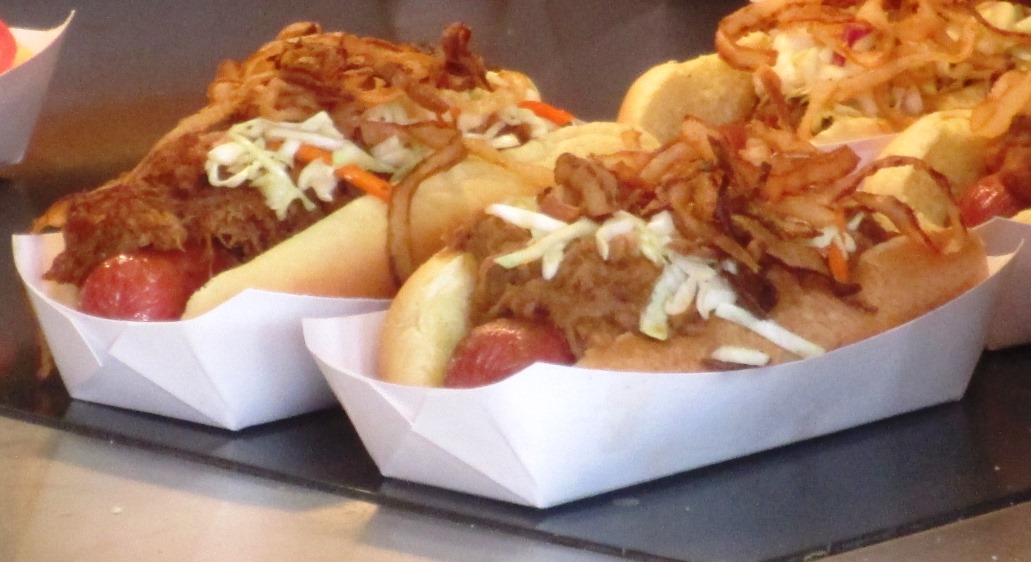
OK I give, where’s the mustard?
Elsewhere on Eutaw are a few of the unique food stands at Camden Yards. There’s the Bud & Burgers and Stuggy’s Gourmet Hot Dogs at the north end, where you can order unusual burgers and dogs (the crab mac and cheese dog is very popular) in case a simple dog doesn’t wow you.
There’s also a Eutaw Street Market in the warehouse where you can find grab and go items, and at the south end is a Eutaw Street Gyro Grill. You may lament the disappearance of the “other” BBQ stand, but the gyros and spinach pies are pretty good. Besides, Boog’s BBQ is plenty BBQ enough.
More Oriole Park Food Options – Crab Stuff!
Oriole Park is still in Maryland last time I looked, so crab stuff is pretty popular. Here are three more favorite Camden Yards food options of mine, just because I love Old Bay…
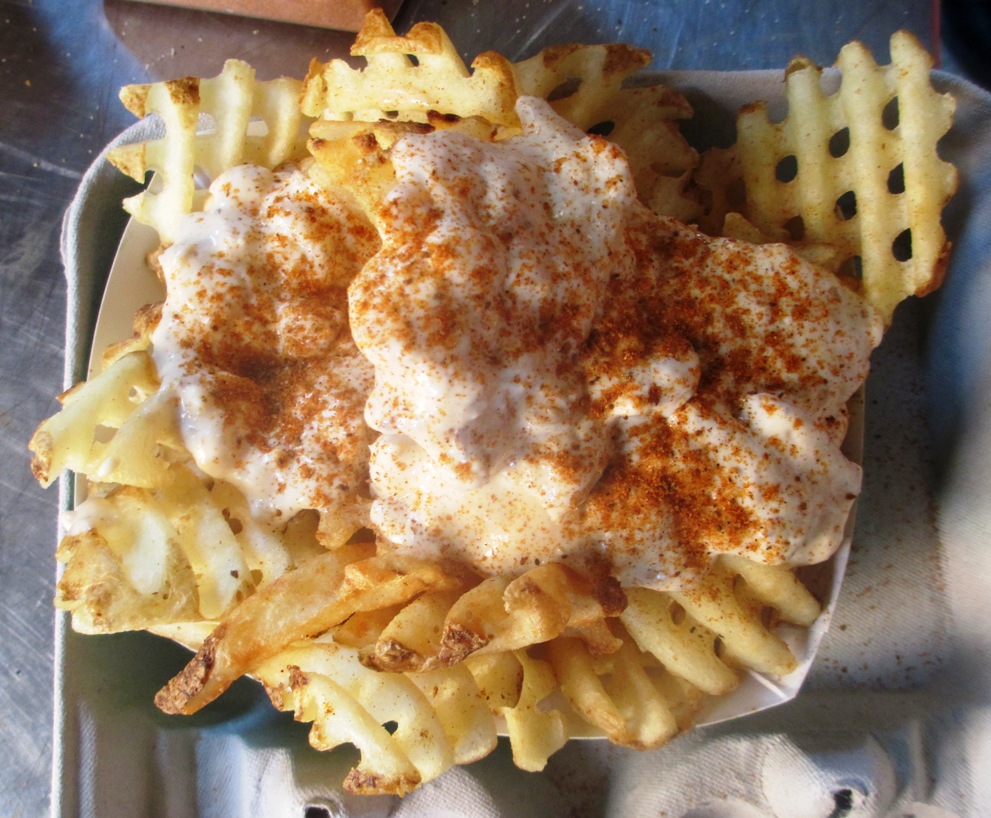
The Old Bay addition makes it Orioles colors!
1) Crab Dip Waffle Fries. This is a pretty big go-to item for Orioles fans. If you’re familiar with the Chick-Fil-A waffle fries (and who isn’t?), they’re like them, but topped with Maryland crab dip sauce, and you can shake on some Old Bay seasoning at a condiment stand.
Get them at Old Bay Seafood, Freestate Fries or the Flying Dog stands, and get a fork and napkins…you’ll thank me.
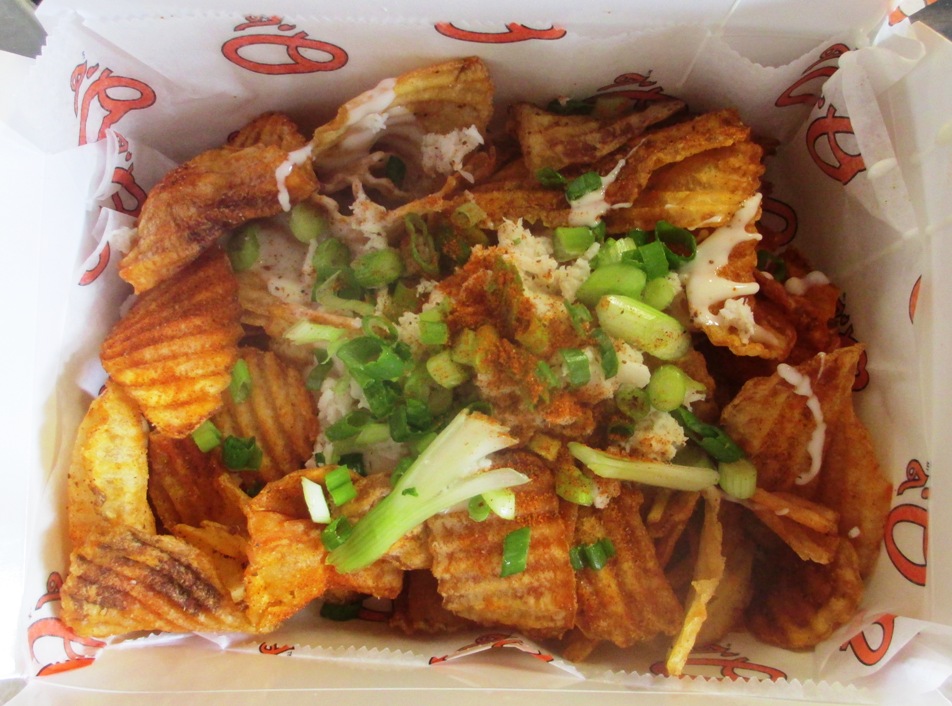
Check out those scallions!
2) The Crab Chipper. The Chipper stand has become one of the more popular Camden Yards food options – and this Crab Chipper features kettle chips (or pork rinds!) topped with crab meat, white cheddar, green onions and Old Bay…so they’re, you know, kind of like fancy nachos.
It’s a decent quantity of food too, especially if you get them in a souvenir helmet. Way salty though, so grab a drink with it…
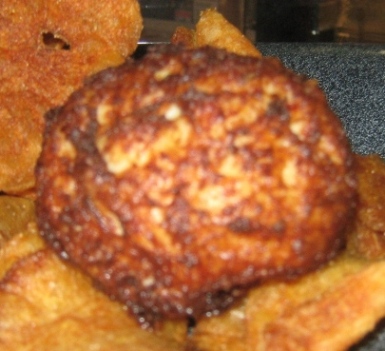
The Official State Fish of Maryland.
3) The Old Bay Seafood Crab Cake. I remember in the early days of Oriole Park watching a friend of mine shell out $4 for a crab cake the size of a golf ball. This was before ballparks were known for food options. Hope he enjoyed it.
Today the crab cakes may be more expensive, but they’re now appropriately baseball-sized and much tastier – the Orioles had a chef sample 50 local crab cakes (!) to come up with a recipe for this delicacy. (Hopefully not at once.) The Old Bay stands are in the lower and upper concourses.
There you go…three crab-tasty Camden Yards food options. But you can go cheap here as well.
Can You Bring Food Into Camden Yards?
The short answer is yes, you can…the Orioles allow a 16*16*8 soft-sided bag or cooler, so long as it doesn’t contain alcohol or potential projectiles.
But the best part of this money-saving tip is the possibilities you have with the numerous outside vendors…so here are three tips on where you can find cheap outside grub to bring into the Yard.
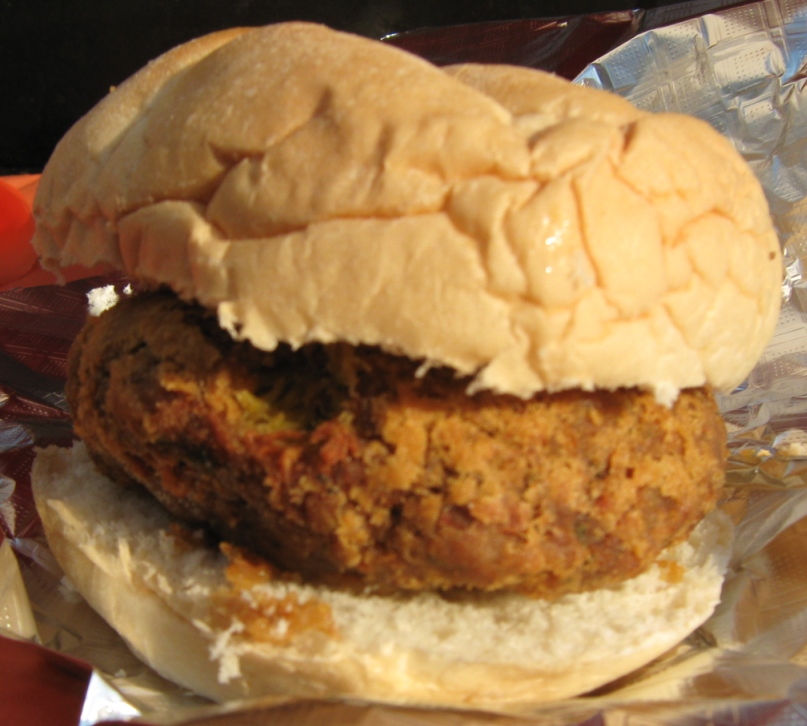
Inside the ballpark, it costs more without the roll.
1) Pickles Pub/Slider’s/The Bullpen. I’m not sure which of these three corner pubs sets up all of the tents and outdoor grills and full bars, but I expect it’s all of them. The three establishments are across the street from the ballpark on Washington Street, and the entire area gets packed with pre- and post-game partiers.
You can get a hefty dog, sausage, burger, or crab cake sandwich here for much less than you’d pay inside the ballpark, of course, and there are tables with people selling peanuts, pistachios and bottled water too.
Best part? Have a cheap Natty Boh while you’re filling your goody bag…since you can’t get cheap beer OR Natty Boh inside the ballpark.
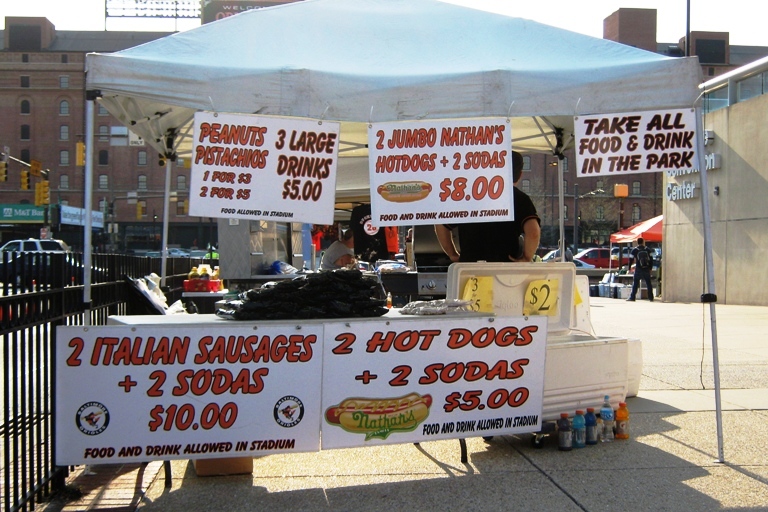
With so many combinations, there’s sure to be one for you!
2) Vendors On Howard And Conway Streets. There are a plethora of vendors with grills selling dogs, sausages and chicken sandwiches, and they’ll offer you a nice deal if you’re willing to haggle and offer to buy more at a discount.
As with the vendors near Pickles Pub, on Conway Street, you can also buy much cheaper gear and souvenirs. This is ideal for people arriving by Light Rail…the vendors are right there across the street.
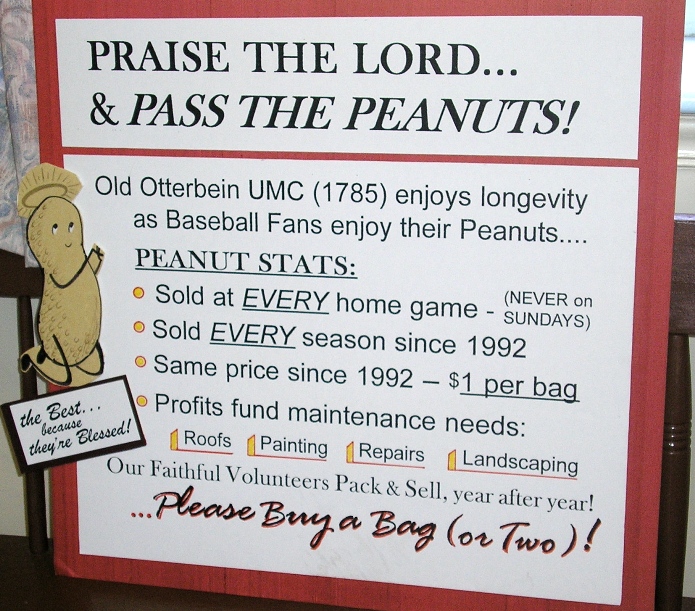
Photo courtesy of the Old Otterbein United Methodist Church. They said I could use it.
3) The Peanut Church. The Old Otterbein United Methodist Church is nicknamed the “Peanut Church”…they’ve been selling fresh bags of roasted peanuts cheaply since Camden Yards opened in 1992, and they’ve used the profits to maintain the church with a new roof and painting and such. If you’re a person of faith you’ll probably think it’s a cool thing. It’s on Conway Street, and if you’re coming from the Inner Harbor you can’t miss it.
Finally, there’s a Jimmy John’s and a Chipotle just steps away, if you want bring food into Camden Yards from someone familiar. But that’s kinda boring.
So there you go…some food options at Oriole Park at Camden Yards. Enjoy, and let me know when you’ll be there.

Product Review: Easy Expressions Hands-Free Nursing Bra

Got milk? Heck yes! Even I couldn’t believe the increase in production from this well-constructed and balanced hands-free nursing bra. It can even be worn in public! Amazon censored this review citing their “sensitivity filter”, so maybe the cow’s milk industry wasn’t happy about my promoting self-reliance. But whatever, five stars!
Got Milk? Heck Yes!
Are you kidding me? I never knew my wife had it in her, so to speak. We have three quarts in the refrigerator and counting! Guess we’ll be making more pudding!
The Easy Expressions bra with the pump is safe, easy to use and nowhere near as cumbersome as it looks. My wife was even able to wear it at work, and while she heard some snide remarks from her customers at Friday’s (one boob–pardon the pun–kept asking which one was skim, another couldn’t stop saying “nice jugs”), it was certainly worth it to be able to produce all that nutrition, all the while serving jalapeno poppers. (Couldn’t do THAT before!)
And two pumping at the same time also ensures balanced wear and tear on the ol’ grapefruits. Way to go Easy Expressions!
Photo credit: _Shward_ on Best Running / CC BY

Book Review: Uranus – The Constant of Change

If you’re really into Uranus, this book is for you! Amazon for some reason blocked this review, citing their “Sensitivity Filter”, so maybe some people thought Neptune deserved equal recognition or something. But whatever, I gave this book five stars for how it helped me get a feel for Uranus!
Get An In-Depth Look At Uranus!
For some strange reason, I’ve always had a deep fascination with Uranus. I’ve even gone as far as to speculate whether Uranus emits an overwhelming odor and if that is why we haven’t yet landed anyone on or near Uranus to explore it more thoroughly. Some of my friends think I go a little overboard with it and that I’m obsessed with Uranus. They’ve even yelled at me during softball games to “Get your head out of Uranus!” which is sort of funny I guess.
This book was full of information and extremely helpful as far as things like the chapter on Uranus cycles. Sometimes even I forget that Uranus is in a constant state of flux! Another cool thing I learned about Uranus was the bit about the positioning of Uranus and how it relates to things like our love life. Who knew that the location of Uranus mattered so much in romance? Uranus just blows me away sometimes!
So if you’d like to learn more about the great mystery that is Uranus, and I think most people do, I highly recommend purchasing this book. It will really help you dig deeply into Uranus!
Photo credit: Royalty-free image collection on Best Running / CC BY
The Curse of The UPS Car
While I was providing thoughtful NASCAR commentary for the Frontstretch, I noticed an interesting phenomenon about UPS-sponsored cars…that drivers either suffered significant decline with the UPS logo their car, or improved dramatically after it was gone. I detailed the whole curious anomaly in the article below, which first appeared on the Frontstretch in September of 2009.
Occasionally you hear comical stories of superstition in motorsports.
Joe Weatherly, whose untimely death in a crash is why stock cars have window nets today, suffered from triskaidekaphobia and once asked NASCAR to call the 13th Southern 500 the “12th Renewal of the Southern 500”. He also once asked to rename his 13th starting position in a race to “12a”.
There are green car phobias, which supposedly traces back to one of the Chevrolet brothers, Gaston, being killed in a Beverly Hills race. Gaston was driving a green car at the time and green has ever since been seen as bad luck, despite Bobby Labonte’s 2000 championship in an Interstate Batteries car.
Junior Johnson and Dale Earnhardt Sr. were both famous for their aversion to peanuts in the garage, and both were the targets of peanut-related practical jokes by team members and fellow competitors. One story told by Robert Yates describes a Johnson crew member painting foam packing peanuts and pretending to eat them near Johnson’s car, which sent Junior through the roof. “He didn’t think that was very funny”, chuckled Yates.
But who knows? Kevin Harvick claimed to lose an engine on a day where there were peanuts around the garage. Sometimes these things do take a life of their own.
With David Ragan pulling the UPS #6 into the Loudon garage after finishing 33rd and 13 laps down, placing him currently 30th in the standings, it’s nearly been forgotten that Ragan was seen as a driver with a bright future not very long ago, when AAA was sponsoring the car.
And it seems that there is some sort of whammy on any car that sports the famous UPS logo. Not anything dangerous, just something that makes racecars slow.
If your racing fan days go back a stretch, you remember how dominant Dale Jarrett once was, as difficult as that may be to believe seeing his last few seasons.
In 1996, Jarrett took over the Quality Car Ford Motor Credit No. 88 for Yates Racing. In that car he won two Daytona 500s, a Coca-Cola 600, and the Winston Cup championship in 1999, after falling 14 points short to Jeff Gordon in 1997. He won 20 races, scored 95 top fives, and 119 top tens in 167 races. That is rare supremacy in this sport.
Then Jarrett and Yates signed on with UPS, launching the now-famous “Race The Truck” campaign. For two years there was a slight downturn: six wins, 22 top fives and 37 top tens, and a fifth and ninth place finish in the standings. That’s hardly terrible in any two seasons, but it was the first noticeable decline in the performance of the No. 88.
Then in 2003, Jarrett fell off a cliff and never fully recovered. He won just one race and that win was his only top five in a season where Jarrett inexplicably finished 27th in points. For the rest of his career at Yates, Jarrett would score only one more win in three seasons and never again finished higher than 15th in the standings.
Despite the drop-off, UPS was happy enough with Jarrett as their spokesman to go along with him to Michael Waltrip Racing in 2007. In retrospect that seems like a giant blunder, but at the time most of the pundits saw the big name sponsors and manufacturer and the veteran’s three car team and predicted big things.
It didn’t work out that way. Jarrett burned his six champion provisionals very early in the season and made just 24 races in 2007, never once finishing in the top ten. At the end of the season, Jarrett finally tired of the aero disadvantages of racing in a parcel delivery truck and announced his retirement after five races in 2008. In those five races his highest finish was a 16th at Daytona.
The UPS hex then fell on David Reutimann. After a 2007 season where Reutimann was the top performer at MWR, Reutimann scored just four top tens in 2008, finally exhausting UPS’s patience despite their own role in driver declines. He still had the best results at MWR, but that wasn’t saying much.
After UPS left, with the much faster Aaron’s logo back on his car, Reutimann not only won his first ever Cup race at Charlotte, but he surprised everyone by challenging for a Chase spot well into the season. Reutimann has scored five top fives in 2009, after managing zero with the heavy UPS logo on the car. As I wrote this, he was also ahead of Dale Earnhardt Jr. and Kevin Harvick in the standings, two drivers that had little trouble acquiring sponsors in their careers. And 13 drivers separated him and the UPS driver.
UPS signed on with David Ragan starting in the 2009 season. In 2008 Ragan, with AAA on the car, seemed to have the best future of the younger drivers. He barely missed the Chase and finished 13th in points, a great improvement over finishing 23rd in 2007. He scored six top fives and 14 top tens in 2008 after scoring two top fives and three top tens in 2007. He had even scored 11th and 13th place finishes at Martinsville, a place where he had once been called a “dart without feathers” by Tony Stewart. Of course it seemed like a wise choice, if you didn’t consider the withering effect that UPS brown had on past drivers.
With the UPS logo on his car, Ragan went from riches to rags. The No. 6 has exactly one top ten this season, in the rain-shortened Daytona 500. Since then Ragan has finished in the top 15 just four times, never higher than 12th. His last three races have been three straight 33rds.
And he is 30th in the standings—if he drops one more position, it will be the same margin of decline that Jarrett suffered from 2002 to 2003.
It may be a strange statistic to look at, but what would be the odds of two different drivers, driving for two different teams, dropping 18 positions in the standings in one season while sharing only a sponsor in common? (And a manufacturer, I suppose, but many more drivers have driven Fords than have for UPS.)
Most all of this can probably be explained away without superstition. Yates in general was beginning a decline when they signed on with UPS. All of Michael Waltrip’s teams have struggled mightily. Roush Fenway has had problems with NASCAR no longer allowing them to test. You could just call it poor timing and foresight on UPS’s part.
But there isn’t any denying a noticeable correlation between a team’s performance with and without a brown UPS logo on a racecar. UPS appeared on Dale Jarrett’s car and he went from contending for titles to fighting to make races every week in just a few years. They appeared on David Reutimann’s car and Reutimann showed little improvement, then after their departure he rocketed to near playoff contention. UPS attached its logo to David Ragan’s car and he has gone from a young driver with a bright future to being one of those drivers who is rarely shown on TV unless he crashes or enters the pits backwards.
No doubt Matt Kenseth breathed a sigh of relief when UPS refused to replace DeWalt on the No. 17.
Did this post make your day a little bit?
I hope so. If it did, I would really appreciate your support.
When you use this link to shop on Amazon, you’ll help subsidize this great website…at no extra charge to you.
Thanks very much…come back soon!
Photo credit: rmkoske on VisualHunt / CC BY-SA
Photo credit: Darryl W. Moran Photography on VisualHunt / CC BY-ND
Photo credit: Dei3Nascar8 on Visual hunt / CC BY
Photo credit: The Freewheeling Daredevil on VisualHunt.com / CC BY
Photo credit: Hans J E on VisualHunt.com / CC BY-SA
Photo credit: pocketwiley on Visualhunt.com / CC BY
What Caused The Decline of NASCAR? A Former Reporter’s Thoughts
In the early 2000s, NASCAR was soaring. It may be difficult for younger people to imagine it, but the sport was once poised to overtake the NFL in popularity. Yes, that’s actually true; read it again if you need to. So what caused the decline of NASCAR to the point where the sport is desperately trying to remain relevant?
I covered NASCAR for six seasons for two excellent racing websites, That’s Racin’ (the Charlotte Observer’s racing site) and the Frontstretch. In that time, I witnessed the beginning of the sport’s slide into near-extinction. I’m also someone who became a disenchanted former fan myself.
Having followed the sport in the time frame when it began, I can offer what I believe are the real reasons for the decline of NASCAR. I can also dispute other reasons for it that I see being offered today. This is all just ultimately my opinion, but it’s a carefully considered one.
I’ll start with a few things that I don’t believe caused the decline of NASCAR, then I’ll share what I think really did.
The Decline of NASCAR, Non-Reason #1: The Cars Are Too Spec
I’ll submit that this is a reason a few fans I know stopped watching the sport. In NASCAR’s pre-1990s heyday, when it was still very much a regional sport, manufacturer identity was a big thing. People rooted for car brands as well as drivers, and car companies believed in the whole “win on Sunday, sell on Monday” mantra.
However, by the time NASCAR was peaking in the early 2000s, there already wasn’t much manufacturer identity left. The cars already were mostly spec at that point, and the sport was doing just fine…booming even. The decline of NASCAR from dominance started circa 2005, and there wasn’t any big change to car specs in that time period.
All that said, the unveiling of the “Car of Tomorrow” in 2007 certainly didn’t help. It was boxy, ugly, and top heavy…and its shape was part of the reason for the Indianapolis debacle of 2008. In that race, caution flags were flown almost every ten laps for tire wear, as Jimmie Johnson limped to a victory. The fan backlash was loud and intense. If any single event hastened the decline of NASCAR, it was Indy 2008.
But in a relatively short time, NASCAR corrected the car and the multiple issues with its design, and while the cars don’t differ by manufacturer like they once did, at least we’re not seeing disastrously awful races just because of the car’s construction. In fact, the current car lends itself to some pretty good racing.
Lack of manufacturer identity may have been a reason some hardcore fans left the sport in the early 1990s, but that doesn’t seem to me to be a valid reason for the sport’s popularity plunge since 2005.
The Decline of NASCAR, Non-Reason #2: It’s Gotten Too Safe
I’m not sure why people would think this, although I’d actually had some heated debates with Tom Bowles at the Frontstretch about it. Bowlesy thinks there needs to be an element of risk for racing to be exciting; I don’t tune in to races to see a car potentially fly into a catch fence and injure spectators.
NASCAR did (and still does) market the possibility of spectacular wrecks. I’ll never forget seeing Elliott Sadler’s terrifying end-over-end crash at Talladega in 2003 – and seeing it again in every single ad for Talladega races for the next 3-4 years. Maybe there is a segment of fans who tune in for death-defying calamities, but that has always been a part of the sport and still is.
I can’t imagine any fan of Dale Earnhardt Sr.…and there were a lot of them…not wanting to see the sport take every measure it could to keep drivers safe after Daytona 2001. This isn’t to say that the initial Car of Tomorrow wasn’t a disaster…it was…but at the time, fans were plenty vocal about safety after the loss of the sport’s biggest icon.
For any fan that needs racing to be dangerous, there are still four restrictor plate races on the schedule. But plate racing still sucks…not only do plates produce multi-car crashes every event, they pervert the standings because of it.
I’m not buying the “it’s too safe” bit as a cause for the decline of NASCAR. Racing is still pretty danged dangerous. Just because no one has been killed at the Cup level since Earnhardt’s death doesn’t make it less so.
The Decline of NASCAR, Possible Reason #1: Jimmie Johnson’s Winning
Jimmie Johnson was a hallmark of ruthless efficiency in his prime, winning seven titles and five in a row. With his brilliant head wrench Chad Knaus on the pit box, the #48 team for years remorselessly laid the field to waste when playoff time started.
Jimmie won a lot. Which meant that other drivers didn’t win a lot. If that contributed to NASCAR’s decline, however, that is on NASCAR.
NASCAR possessed one of the greatest dynasties in the history of sports during Jimmie’s reign. Yet instead of focusing their marketing on Johnson’s unequaled supremacy, NASCAR chose to put all of their marketing eggs into the Danica Patrick basket, believing a swimsuit model who could drive a racecar would save the sport.
Danica turned out to be a huge bust…as many people who followed the sport closely, including yours truly, predicted she would be. (It wasn’t a tough call to make, if you actually looked at her results instead of her figure.)
Dynasties like Johnson’s aren’t bad for a sport…unless the sport doesn’t know how to market them. The Yankees were always good for baseball. Tiger Woods was great for golf. The Patriots’ domination was great for the NFL. People love a winner, they love to hate a winner, and they love to see a dynasty get taken down. The #48 team should have been a gold mine.
So no, Johnson’s domination wasn’t directly a factor in the decline of NASCAR – but their failure to market it most definitely was.
The Decline of NASCAR, Possible Reason #2: Dale Earnhardt Jr.’s Losing
By virtue of his father’s untimely passing, Dale Earnhardt Jr. instantly found himself with a larger fan base than any three drivers in NASCAR. As the son of one of the greatest racecar drivers in history, Junior also had an impossible standard to live up to.
But for whatever reason, Junior not only didn’t measure up to his father’s formidable reputation, he rarely even established himself as a contender. Much like Kyle Petty, he ultimately became more known for his good-guy personality and his lineage than for his achievements on the racetrack. As Junior’s fortunes continued to trend downward even while driving for the strongest team in the sport, his fan base became turned off. And he had a very large fan base.
It could be argued that Junior was the sport’s last link to its tobacco-chewing, Southern past; once Jeff Gordon tore up the sport, drivers started to appear from every corner of the country. But the sport’s most dedicated fans were (and are) still in the Southeast, and Southerners are loyal to the core to their heritage.
It’s possible that the most popular driver not performing well hurt the sport, given the sport’s fan demographic. However, like Johnson’s dominance, I doubt that this would have been as much of a problem were it not for other factors that were far more damaging.
So here are three actual reasons for the decline of NASCAR. Still with me? OK, here we go.
The Decline of NASCAR, Actual Reason #1: The Chase
One of Brian France’s very first acts as CEO of NASCAR sealed his doom as a respectable heir to a business, and nothing he did for the rest of his tenure would change that perception.
I don’t often see NASCAR’s ill-conceived playoff idea as a reason people cite for the decline of NASCAR in articles I read these days, but I promise you, that was not the case when I covered the sport. NASCAR’s initial playoff brainchild was hugely unpopular, and every griping fan in comment sections of blogs everywhere had the artificial points reset near the top of their list of complaints.
It’s not so much that the points reset NASCAR introduced in 2004 was a monumentally stupid idea. It was, but even that wasn’t the point. It was the insistent implementation of it over loud objections of fans. NASCAR polled fans about the idea on their website following the 2003 season, and fans overwhelmingly rejected it. They shut down the polls and went ahead with it anyway.
If you want to attribute the decline of NASCAR to arrogant leadership, look no further than that single act. It was blatant condescension towards what was arguably the most loyal fanbase in sports. Why poll the fans if you’re just going to ignore them?
That and it really was a stupid idea.
In case you weren’t there or don’t remember, in 2004 NASCAR welcomed their new series sponsor, Nextel (now Sprint), with a new “playoff” system called the “Chase”. After 26 of 36 races, the top ten drivers would have their points reset, putting them all on a level playing field again for the last ten races.
Yes, NASCAR actually believed an artificial points reset after two thirds of the season was the move that was going to catapult them past the NFL.
Making matters worse, within four years, the driver with the second largest fan base finished with the most points in a season twice, only to lose the title to a points reset.
It’s not often noticed, but it was definitely noticed by Jeff Gordon fans: had NASCAR not implemented the Chase, the driver of the iconic #24 could have been the one standing aside Dale Earnhardt and Richard Petty today with seven titles, instead of his protégé Jimmie Johnson. Gordon scored the most points overall of any driver in 2004, 2007, and 2014. Nothing against Jimmie Johnson for winning titles with the rules as written, but he only managed that feat twice.
Gordon wasn’t the only driver who turned in a spectacular season-long performance only to have it nullified. In 2008 Kyle Busch smoked the field for the first 26 races, winning eight of them and setting the NASCAR world on fire with his brash and unapologetic racing style. After two DNFs in the first two Chase events resulting from simple bad luck, just like that his title hopes were gone. I was critical of the Chase in plenty of columns, but I felt like I really got the point across with this one about it.
It’s largely forgotten now, because the sport’s current elimination format playoff system at least had some thought put into it. It rewards winning, which rewards fighting for wins, which creates rivalries.
But the initial “Chase”, an artificial and contrived points reset, was despised by fans. It was a radical change to a sport that didn’t need radical changes. You could say it was NASCAR’s New Coke, except Coca-Cola was smart enough to change the formula back in response to furious customer backlash.
If they hadn’t, you’d probably be reading articles today about the decline of Coca-Cola too.
The Decline of NASCAR, Actual Reason #2: The Broadcasts
I don’t need to tell anyone who was a fan in the 2000s this, but NASCAR’s broadcasts at the time may have been the worst in the history of sports. Fox Sports’s coverage was particularly abominable, with a seemingly endless parade of commercial interruptions mixed with the Ford Cutaway Car, the Home Depot Pit Crew Member, the Viagra Boner Of The Race, whatever, all during green flag racing.
Mike Joy is an outstanding announcer, and it was never a big deal for a fan to mute Darrell Waltrip’s exponentially annoying “boogity boogity boogity!” at the green flag. But it was a never ending source of irritation to see five laps of racing followed by a several minute commercial break, which was then followed by another minute of a wide angle shot of the venue and “This race is being brought to you by <several companies who also paid an obscene amount of money to NASCAR>.”
There were often times…and I’m not exaggerating this…when a viewer would see maybe five laps of racing, a two-minute break, and then just two more laps of racing before another break. Anyone who was watching then could tell you that wasn’t unusual at all.
This was a problem that actually needed to be addressed and wasn’t. NASCAR blew off fan demand for picture-in-picture commercial breaks…something they’ve since embraced…while Fox Sports’s indifference to fans went completely unchecked. It was another case of costly arrogance; as much as fans loved NASCAR, they didn’t love it enough to put up with an endlessly saturated marketing campaign featuring occasional snippets of racing each week.
One shining example was a 2010 Dover race…a “playoff” race, no less…where ESPN broke away with 11 laps to go in a very much undecided event for an ad break. Dover is a 1-mile track, and 11 laps does not take long. I remember watching it and literally wondering if I was going to see the finish of the race. I wasn’t the only one who noticed…as this blog post’s comments demonstrated.
NASCAR made an absurd amount of money with their television contracts in the 2000s, but that ultimately cost them a sizable chunk of the audience when networks were forced to make it worth their while. The broadcasts really were over-saturated with ads enough to drive fans away.
And I said all that without even bringing up that profoundly irritating cartoon gopher.
The Decline of NASCAR, Actual Reason #3: The Venues
Speaking of disrespecting your fan base, how about needlessly putting an end to a beloved 54-year tradition? That’s exactly what NASCAR did when they took the Labor Day race out of Darlington and sent it to Auto Club Speedway in California. It took quite a few years of longtime fans bitching about that, but NASCAR did finally move the Labor Day Southern 500 back to Darlington.
The move of the Labor Day race to California was part of an ongoing trend. In response to its rapidly growing popularity nationwide, NASCAR moved away from the Southeast fans who brought the sport to the dance, and began holding races in places like Vegas, Chicago and Los Angeles.
But that in itself wasn’t necessarily the crime. You couldn’t entirely blame NASCAR for no longer holding events in places like North Wilkesboro or Rockingham or even Darlington, which lost a race on the schedule for several years. The markets simply couldn’t support them anymore.
The problem was the tracks that replaced them…nearly all of them were characterless, cookie-cutter speedways where aero package ruled the day. In 1994, there were six events held at intermediate tracks of 1.5-2 miles in length. Just ten years later, there were 13 such events…nearly half the schedule.
That isn’t insignificant when it comes to explaining the decline of NASCAR. When you think of the venues that have showcased the most memorable events in the sport’s history, Daytona, Darlington, and Bristol often come to mind. Atlanta has had some classics, but that was partly by virtue of the venue hosting the championship race, such as Alan Kulwicki’s unforgettable title win in 1992.
NASCAR moved away from tracks where drivers push and shove and fight both other racecars and the track, and moved to aero-dependent speedways where engineers in the garage determined winners. As a result, teams with more resources…such as Hendrick Motorsports and Roush Racing…won big for years.
But more importantly, the racing isn’t anywhere near as exciting at the cookie cutters, as I so eloquently explained here. I also suggested a solution…that NASCAR emulate how baseball exploded in popularity after the opening of Camden Yards. Even more so than in baseball, the on-screen product is affected with the layout of a track. It makes a world of difference watching on TV.
You also don’t often see post-race fisticuffs after races at Kansas or Vegas like you might at Martinsville or Bristol. Those moments generate interest…and rivalries, which every sport needs.
Fortunately, NASCAR is finally addressing this…
How NASCAR Can Rise Again
I have reasons to believe that NASCAR can return to previous levels of popularity…maybe not on the verge of overtaking the NFL again, but at least back to a point where they have enough of a dedicated fanbase to be a solid performer in ratings and ticket sales.
Since this is a non-ideological blog, I won’t get into the things that the NFL, NBA and MLB have recently done to drive away a significant portion of their fanbases. We all know what I’m talking about. I expect that will be a boon to NASCAR’s future.
As I’ve said, the sport is finally addressing its venue problem. The 2021 campaign includes six road course races, a dirt race at Bristol (!), and a race at the concrete venue of Nashville for the first time. Labor Day is in Darlington where it belongs, and Darlington is hosting two events again. And the season will conclude at Phoenix again, a more exciting venue than Miami where the finale had been for years. There are still 11 races on “intermediate” tracks, but it’s finally moving in the right direction.
These are bold changes, but this variety of tracks will test drivers and teams at every level. No longer will teams win titles by dominating speedways; driver skill will be more of a factor, as it should be.
In addition, the current playoff format, while far from perfect, isn’t nearly as unpalatable as the Chase was. It rewards winning and risk taking, where the Chase rewarded points racing and avoiding risk. Yes, a team can still dominate all season and lose a championship to a flat tire, but at least it’s not just an artificial points reset. With the current playoff point structure, drivers are also somewhat rewarded for strong season-long performances as well…while the Chase completely disregarded excellence during the season.
The broadcasts have also improved. There are still plenty of obscene profit breaks, but it’s far less aggravating when you can still see the action and leader board on part of the screen. NASCAR was plenty defiant resisting this idea at their peak…but these days, they’re not in a position to ignore displeased fans.
The sport no longer has Dale Earnhardt Jr. or Jimmie Johnson, so there’s an opportunity for new fan favorites to emerge, formed by on-track performance rather than sentiment. Veterans like Kyle Busch and Kevin Harvick are future Hall of Fame drivers with fairly large followings, and a strong crop of young drivers are making names for themselves.
NASCAR’s 2020 champion is also its most popular driver…for the first time since 1988. Chase Elliott, like his 1988 champion father Bill, is from Dawsonville, Georgia…the Southeast…and he has the lineage factor as the son of a well-liked champion. Nepotism isn’t dead in NASCAR. Elliott is a great driver and a likable kid, and he doesn’t take any crap…he doesn’t shy away from wrecking a driver like Denny Hamlin if the situation called for it. (It did.) He is likely to build a fan base fast.
The decline of NASCAR was a combination of ill-considered decisions: the implementation of a contrived playoff, poorly thought out broadcasting contracts, and departing from unique and venerable venues for dull, unexciting ones. It didn’t help that a hugely popular driver underperformed, but that shouldn’t have caused this much of a free fall.
After years of seeing its once enormous audience dwindle to almost nothing, NASCAR is finally righting the ship. Ousting Brian France, who created the Chase and presided over the sport’s decline, was no small part of that. But they’ve also improved the schedule, the broadcasts, and the method of determining a champion. It took time, maybe too much time, but NASCAR is finally addressing the three biggest reasons for the decline of the sport.
And while 2020 has been anything but usual especially in the sports world, NASCAR was the one sport that didn’t suffer a significant ratings drop. For the first time in over a decade and a half, they seem to be headed in the right direction.
So if I’m right, in a few years NASCAR may become America’s summer sport again.
And maybe this time, they will have learned from their mistakes.
Did this post make your day a little bit?
I hope so. If it did, I would really appreciate your support.
When you use this link to shop on Amazon, you’ll help subsidize this great website…at no extra charge to you.
Thanks very much…come back soon!
Photo credit: brandonzeman on Visual Hunt / CC BY-SA
Photo credit: Zach Catanzareti Photo on Visualhunt.com / CC BY-SA
Photo credit: wjarrettc on Visual hunt / CC BY
Photo credit: sidehike on VisualHunt / CC BY-SA
Photo credit: Zach Catanzareti Photo on Visualhunt / CC BY-SA
Photo credit: PresidenBertho on Visualhunt.com / CC BY-SA
Photo credit: sarahstierch on Visualhunt.com / CC BY
Photo credit: tequilamike on Visual hunt / CC BY
Photo credit: Zach Catanzareti Photo on VisualHunt.com / CC BY-SA
Photo credit: Zach Catanzareti Photo on Visualhunt / CC BY-SA
Photo credit: sidehike on Visual hunt / CC BY-SA
Photo credit: Darryl W. Moran Photography on Visual Hunt / CC BY-ND
Photo credit: eliduke on Visualhunt.com / CC BY-SA
Photo credit: Ford Racing on VisualHunt / CC BY
Photo credit: royal_broil on Best Running / CC BY-SA
Photo credit: PDA.PHOTO on Best Running / CC BY-ND
Photo credit: balpeck on Best Running / CC BY-SA
Photo credit: “Fast” Eddie Maloney on Best Running / CC BY-SA
Photo credit: Zach Catanzareti Photo on Best Running / CC BY
Photo credit: Zach Catanzareti Photo on Best Running / CC BY
Photo credit: Zach Catanzareti Photo on Best Running / CC BY-SA